
Thoughts on the 2nd Day of Adnan’s Reopened PCR
Last night, we had another special minisode of the Undisclosed Podcast based on the second day of the reopened postconviction review proceedings in the Adnan Syed case. In this post, I will expand upon some of the topics I covered in the minisode. First, however, I will touch upon the key cell tower testimony by Gerald R. Grant, Jr.
The Cell Tower Testimony

The case Jessie is referencing is the Bulos Zumot case. We discussed it on the Ping episode of the Undisclosed Podcast. Here is a discussion of the cell tower testimony in the case:
Although it is not known to be true of all companies, it was established in this case that, according to AT&T records, if a call is placed from one cell phone to another and the call goes into the recipient’s mail box, the AT&T call shows as connected. However, the tower reading will reflect the tower from which the call originated. In this particular case, the defendant’s private investigator noted that a call was placed on an unrelated day a week before the incident when the defendant was, again, known to be in the San Jose area.
The defendant’s cell tower records showed an incoming call placing the defendant near a tower in Lahaina, Maui, and within nine minutes of that call, a previous call placed the defendant in Palo Alto. Because of this “flaw” in AT&T’s system, by all rights, the defendant received the first call from a tower on the island of Maui, some 3,000 miles away. The prosecution’s expert was then asked under oath, “Can you get from San Jose to Maui in nine minutes?” Again, their “expert” replied, “It depends on your mode of travel.” A valuable lesson in how not to choose an expert. (emphases added).
Indeed, there is no dispute on this issue. This comes from Zumot’s opening appellate brief, People v. Zumot, 2012 WL 2395582 at *22 n.9 (Cal.App. 6 Dist. 2012)
At trial, however, Lawrence Velasquez testified for the defense. (19 RT 1908.) Velasquez was an ATT radio frequency engineer. (19 RT 1907.) He explained that when an ATT customer calls another ATT customer and it goes to voice mail, the site tower listed on both customers’ records is for the location of the caller only. (18 RT 1912-1914.) The calls from Mr. Zumot to Ms. Schipsi — which went to voicemail — between the hours of 2:56 pm and 7:45 p.m. show Mr. Zumot’s site tower location on both records not because the phones were together in Mr. Zumot’s possession (as the state theorized), but because Mr. Zumot (an ATT customer) was calling Ms. Schipsi (another ATT customer) and the calls went directly to voice mail. (18 RT 1912-1914.) The state presented no rebuttal to this evidence. (emphasis added).
Meanwhile, here is the corresponding language in the Respondent’s Brief by the State, People v. Zumot, 2012 WL 5990589 at *22 (Cal.App. 6 Dist. 2012)
Lawrence Velasquez, an AT&T employee, testified that when two parties subscribe to AT&T, a call which goes to voice mail only pings at the calling person’s location. (18 RT 1914, 1921.) In addition, one phone call could simultaneously ping off multiple cell phone towers in order to give customers increased reliability in service and to avoid dropped calls. (18 RT 1916.) Pings at multiple towers did not necessarily mean that the phone was moving in the vicinity of all those towers. (18 RT 1918.) (emphasis added).
The takeaway from this testimony is clear: For any incoming call on Adnan’s call log that showed up as “connected” and pinging a certain tower, the call could in fact have been an unanswered call that went to voicemail, with the tower listed being the tower pinged by the caller. This includes both the incoming 7:09 and 7:16 P.M. calls that pinged the L689B tower. This also provides a clear explanation for the AT&T disclaimer:

I saw it mentioned on Twitter that the State might try to claim that “location” on the disclaimer refers to the “Location1” column on a different type of cell phone record than the one included in Exhibit 31:

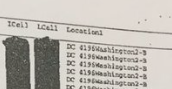
But that makes no sense when you read the above two sentences from the disclaimer together. The statement that outgoing calls are reliable for “location status” while incoming calls are not reliable for “location” clearly means that you can’t use incoming calls to determine the “location status” of the phone, not that you can’t trust the data in the “Location1” column.
So, Grant’s testimony seems pretty clear: The disclaimer meant that incoming calls could be unreliable and therefore shouldn’t have been admitted or served as the basis for Waranowitz’s testing without further explanation from AT&T. This is consistent with what Waranwitz said in his affidavit:
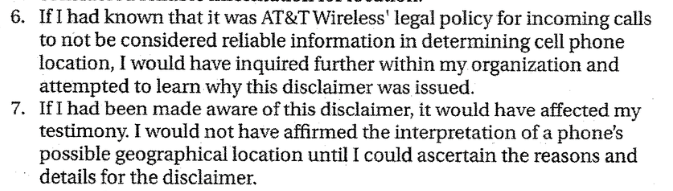
Now, we know the answer that Waranowitz would have been given if he spoke to a knowledgeable AT&T radio frequency engineer such as Lawrence Velasquez: The disclaimer was issued at least in part because, in the records, the tower pinged by incoming calls was sometimes the tower pinged by the caller.
Today, Special Agent Chad Fitzgerald of the FBI will be called as a cell tower expert. Normally, this would set up what’s known as a “battle of the experts” between the defense and the State. But the battle isn’t simply between Fitzgerald and Grant; it’s Fitzgerald vs. Grant and two AT&T radio frequency engineers (Waranowitz and Velasquez) over the interpretation of AT&T records.
The Reliability of Asia and Her Letters

The Deputy Attorney General engaged in a vigorous cross-examination of Asia McClain that seemingly tried to accomplish three goals. The first was to try to establish that Asia’s second letter was written after March 2nd, the date written on the letter. These questions were pretty easy to parry, and it seems as if Adnan’s attorney did just that with newspaper articles and a news clip.
How did Asia know to write “Central Booking” in her second letter on March 2nd? The March 1st Baltimore Sun article on his arrest noted that “Adnan Musud Syed was arrested about 6 a.m. at his home in the 7000 block of Johnnycake Road in Woodlawn, Baltimore County, and taken to the Central Booking and Intake Center.”
How did Asia know Adnan’s inmate number on March 2nd? Maybe she called Central Booking, or maybe Adnan’s family told it to her when she visited their house on March 1st. After all, Adnan was given his inmate number basically right after he was arrested.
How did Asia know Hae’s body was found in a shallow grave? It was in several news clips. How did Asia know about some of the forensic evidence in the case? This is from Debbie’s March 26th interview with police:
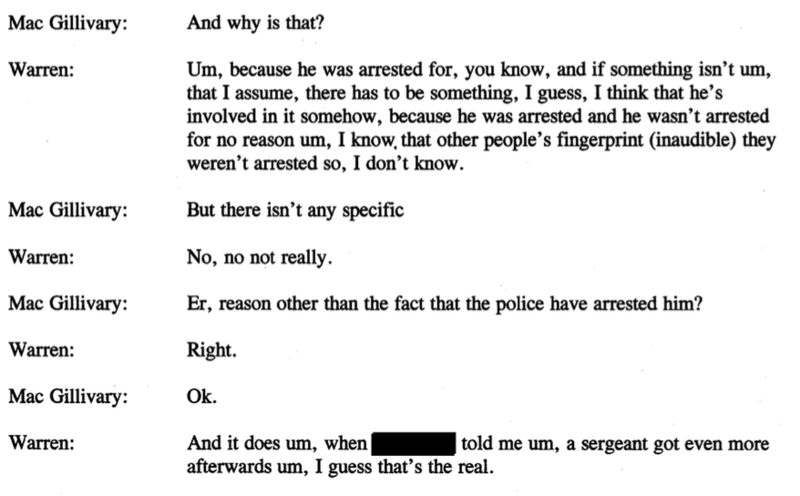
The redacted name is Ann’s name. We know that Ann, Debbie, and Aisha were interviewed by police on March 2, 1999, the same date as Asia’s second letter. Debbie’s interview certainly implies that the police told Ann about some of the evidence in the case on that date, and Debbie herself talks about the fingerprints that were found. Asia testified yesterday that the information in her second letter was based upon gossip at school. If that gossip weren’t merely idle speculation, it easily could have come from information given by the police. Of course, the notes for these March 2nd interviews are “missing” from the State’s files.

The second thing that the Deputy AG tried to do was establish that Asia and Rabia had different recollections of how they met up in 2000 when Asia wrote her initial affidavit. This seems like a pretty trivial point given that Asia reaffirmed that the affidavit wasn’t written under pressure. It’s not hard to imagine Rabia (in 2012) and Asia (in 2016) having different recollections of where they first met back in 2000.
Indeed, as I noted in a post last week, an Illinois judge recently granted a new trial based on failure to contact an alibi witness, even though that witness’s recollection of the actual circumstances of the alibi differed from the recollection of other witnesses:
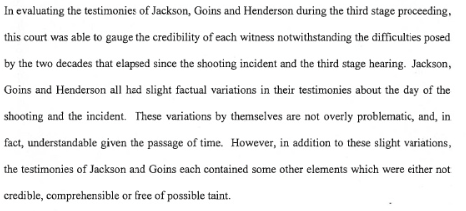
Given that the variations about the actual alibi in the Illinois case were not “overly problematic,” it’s hard to imagine some “decade later” variations about how Asia and Rabia met up are anything other than trivial.

The third thing that the Deputy AG tried to do was to establish that Gutierrez might have read Asia’s letters and made the strategic decision not to contact her based upon their content. Asia explained what her 17 year-old self meant with certain language, but that still leaves the question of how Gutierrez might have interpreted them. Luckily for Adnan, Gutierrez’s interpretation of these letters couldn’t relieve her of the obligation to contact Asia.
Montgomery v. Petersen, 846 F.2d 407 (7th Cir. 1988) has been cited with approval in In re Parris W., 770 A.2d 202 (Md. 2001), and Griffin v. Warden, Maryland Correctional Adjustment Center, 970 F.2d 1355 (4th Cir. 1992). It’s the case in which defense counsel not only contacted but also called twelve alibi witnesses. That said, defense counsel did not contact a thirteenth alibi witness, a Sears clerk, because he doubted the reliability of that alibi. In finding ineffective assistance, the Seventh Circuit concluded:
Nor can we say that defense counsel’s conclusory statement that he did not believe his client was an adequate basis for ignoring such an important lead. Indeed, if counsel had taken the few steps necessary to identify and interview the Sears clerk, he may well have formed a more favorable view of his client’s veracity.
In other words, an attorney can’t trust her gut in failing to contact an alibi witness based on the belief that the alibi isn’t credible. That’s because actually talking (or having someone talk) to the alibi witness could make the attorney view the alibi more favorably. Over the last two days, Judge Welch has had just that opportunity to assess Asia McClain’s veracity. I can only rely on what I’ve heard reported on her testimony, but it seems to me like that process has gone well.
-CM