
More About the EDTA Case That’s Crazier Than the Steven Avery/”Making a Murderer” Case
This is my third in a series of posts about EDTA testing in the Steven Avery/“Making a Murderer” case (prior posts here, here, and here). It’s also my second post about the Kevin Cooper case, in which Cooper claimed that the presence of EDTA in the blood on a t-shirt recovered near the murder site proved that the police had planted the blood, calling into question all of the evidence against him. On the eve of Cooper’s execution, the Ninth Circuit granted his successor petition and remanded Cooper’s case to district court for EDTA testing. In Cooper v. Brown, 510 F.3d 870 (9th Cir. 2007), a three judge panel of the Ninth Circuit found that this EDTA testing was (1) properly done but inadmissible; and (2) unhelpful to Cooper.
Cooper than moved for rehearing en banc by the entire Ninth Circuit. That Ninth Circuit denied Cooper’s request in Cooper v. Brown, 565 F3d 581 (9th Cir 2009), but five judges dissented in an opinion written by Judge Fletcher. Here is a portion of the introduction of Judge Fletcher’s dissent, which hits the high points. The rest of the post after the page break will delve into some of the details. According to Judge Fletcher:
As will be described in greater detail below, the district court impeded and obstructed Cooper’s attorneys at every turn as they sought to develop the record. The court imposed unreasonable conditions on the testing the en banc court directed; refused discovery that should have been available as a matter of course; limited testimony that should not have been limited; and found facts unreasonably, based on a truncated and distorted record.
The most egregious, but by no means the only, example is the testing of Cooper’s blood on the t-shirt for the presence of EDTA. As will be described in greater detail below, the district court so interfered with the design of the testing protocol that one of Cooper’s scientific experts refused to participate in the testing. The district court allowed the state-designated representative to help choose the samples to be tested from the t-shirt. The court refused to allow Cooper’s scientific experts to participate in the choice of samples. Indeed, the court refused to allow Cooper’s experts even to see the t-shirt. The state-designated lab obtained a test result showing an extremely high level of EDTA in the sample that was supposed to contain Cooper’s blood. If that test result was valid, it showed that Cooper’s blood had been planted on the t-shirt, just as Cooper has maintained.
A careful analysis of the evidence before the district court strongly suggests that the result obtained by the state-designated lab was valid. However, the court allowed the state-designated lab to withdraw the test result on the ground of claimed contamination in the lab. The court refused to allow any inquiry into the alleged contamination. The court refused to allow Cooper’s experts to review the bench notes of the state-designated lab. The court then refused to allow further testing of the t-shirt, even though such testing was feasible.*
Let’s now turn to the specific points that Judge Fletcher made in his dissenting opinion.
Daubert
The Daubert test is the test that federal (and many state) judges use to determine the reliability and admissibility of expert evidence. It contains two prongs:
First, [the court] must determine nothing less than whether the experts’ testimony reflects “scientific knowledge,” whether their findings are “derived by the scientific method,” and whether their work product amounts to “good science.”… Second, [the court] must ensure that the proposed expert testimony is “relevant to the task at hand,”… i.e., that it logically advances a material aspect of the proposing party’s case.
According to Judge Fletcher,
The district court confused the reliability of EDTA testing, the first prong of the Daubert analysis, with the issue of what that testing can prove, the second prong of the Daubert analysis….It was uncontested at the 2004-2005 hearing in the district court that laboratory testing can reliably determine the amount of EDTA in any given sample….
The only contested issue was the second prong-what the presence of EDTA proved or tended to prove….
It is hornbook law that evidence is admissible under Daubert if there is an accepted scientific method for making a reliable measurement, even if the evidentiary significance of the measurement can be disputed….For example, courts (including the trial court in this case) regularly admit evidence of Luminol testing for the presence of blood, even though Luminol does not indicate the origins of the detected blood. In fact, Luminol does not even definitively prove the presence of blood. As noted above, other common substances, including bleach, also react with Luminol….The district court in this case repeatedly referred to the results of Luminol testing as probative of Cooper’s guilt….EDTA test results, like Luminol test results, satisfy the second prong of Daubert because they “logically advance [ ] a material aspect of [Cooper’s] case.”
Therefore, Judge Fletcher concluded that the testing showing the presence of EDTA in the blood on the t-shirt should have been deemed reliable and admissible.
Errors With the EDTA Testing
Judge Fletcher then laid out six errors with the EDTA testing in the case before going into detail on these errors. Here were these errors:
First, the district court refused to allow any of Cooper’s experts to assist in choosing the portions of the t-shirt to be tested. Indeed, the court refused to allow Cooper’s experts even to see the t-shirt.
Second, the district court refused to allow any testing of the samples chosen in order to determine whether the stains on the samples were actually blood stains.
Third, the district court refused to permit discovery into why blood from vial VV-2-the blood taken from Cooper two days after his arrest-contained the DNA of two different people. One obvious explanation is that someone removed some of Cooper’s blood from the vial and then added someone else’s blood to conceal the fact that he or she had removed Cooper’s blood.
Fourth, when the state-designated laboratory came back with a result of an extremely high level of EDTA in the sample supposed to contain Cooper’s blood, thereby indicating that the blood had been planted, the lab director withdrew his results because of unspecified “contamination” in his lab. The district court refused to permit Cooper’s attorneys to see the lab’s raw data or notes, thereby preventing an inquiry into whether, in fact, there had been contamination, and into the significance of such contamination.
Fifth, the district court erroneously concluded that several samples from the t-shirt were proper “controls” when, in fact, they were not. These samples contained both human DNA and EDTA, which indicated that they likely contained blood that had been planted on the t-shirt. Because the district court erroneously concluded that these samples were proper controls, it erroneously disregarded the test results obtained by the two laboratories.
Sixth, when the district court concluded that the results of the EDTA testing were inconclusive, it refused to permit more testing, even though such testing was feasible. (emphases added).
Obviously, all of these points are important, but I will solely focus on the fourth and sixth points. With regard to the fourth error, Judge Fletcher noted that
Dr. Maddox of the Orchid Cellmark laboratory sent a total of ten samples to each of the two designated testing labs. Dr. Siuzdak was the tester designated by the State. Dr. Ballard was the tester designated by Cooper.
Sample 1 was a piece of the t-shirt that had been chosen by Dr. Maddox and Mr. Myers as likely to contain Cooper’s blood. Samples 2-6 were taken from other parts of the t-shirt and were intended to serve as controls. Samples 7-10 were not taken from the t-shirt; they were also intended to serve as controls.
As I will explain below, the EDTA results obtained by Dr. Siuzdak and Dr. Ballard are remarkably consistent for all of the samples except Sample 1 and Sample 8. Dr. Siuzdak found that his piece of Sample 1 (the sample supposedly containing Cooper’s blood) contained an extremely high level of EDTA, more than twice as high as any other sample. If Dr. Siuzdak’s piece of Sample 1 contained Cooper’s blood, and if his EDTA result is valid, this indicates that Cooper’s blood was planted on the t-shirt. By contrast, Dr. Ballard found that his piece of Sample 1 contained a somewhat elevated, but fairly low, level of EDTA.
Dr. Siuzdak submitted his report, containing the high EDTA reading for Sample 1, to the district court on October 5, 2004. On October 27, without prior warning, Dr. Siuzdak withdrew his report. His fax to the court stated in its entirety:
On Monday, October 5th I submitted a report on the Cooper samples tested for the presence of EDTA. I now believe that the samples tested were contaminated with EDTA in my laboratory and therefore must retract the report submitted. I deeply apologize for the inconvenience and confusion this report may have caused….
Cooper moved to be allowed access to Dr. Siuzdak’s raw data and bench notes relevant to his testing of all the samples….The district court denied this access….Cooper has never been permitted to see Dr. Siuzdak’s raw data and bench notes, and has never been permitted to investigate the nature and possible significance of the purported contamination. Dr. Siuzdak has never been asked to provide an explanation for his conclusion that there was contamination in his lab. (emphases added).
Breaking this down: (1) Both Dr. Ballard and Dr. Siuzdak did EDTA testing; (2) Dr. Siuzdak’s testing, if valid, indicated that Cooper’s blood was planted on the t-shirt; (3) Dr. Siuzdak withdrew his report without prior notice, making a claim of contamination that has never been investigated or explained; and (4) despite this claim of contamination, the results of the two doctors were remarkably consistent, except with regard to two samples.
Judge Fletcher then fleshed out this analysis while addressing the sixth error. There was a lot to his analysis. Here is what I consider to be the most pertinent portion:
First, we can conclude that Dr. Siuzdak’s EDTA results are very likely valid based on a comparison of his results with those of Dr. Ballard. A comparison of the results for Samples 2-7 and 9-10 (that is, excluding Samples 1 and 8) shows that the results obtained by Dr. Siuzdak and Dr. Ballard are consistent. Dr. Siuzdak’s results are expressed in higher absolute numbers than Dr. Ballard’s, but the relative numbers of the two are remarkably consistent. This may be seen in the following graph:
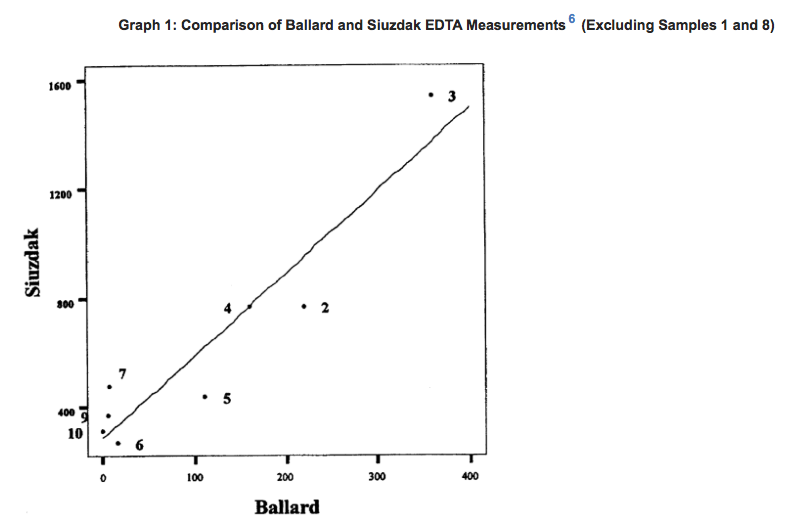
The consistency in results for Dr. Siuzdak and Dr. Ballard strongly suggests that Dr. Siuzdak’s results are valid. That is, if Dr. Siuzdak had EDTA contamination in his lab or if his instruments were miscalibrated, the contamination or miscalibration affected all of his measurements equally. If this is true, Dr. Siuzdak’s results-as measurements of relative rather than absolute amounts of EDTA-are valid.
For purposes of this comparison (and of the above graph), I excluded Samples 1 and 8. Sample 8 is a control not taken from the t-shirt. It is a piece of cloth onto which Dr. Maddox at Orchid Cellmark had placed a known amount of EDTA-preserved blood, with a known concentration of EDTA. Both Dr. Siuzdak and Dr. Ballard found greatly elevated levels of EDTA in Sample 8, though Dr. Siuzdak found a relatively higher EDTA level. That difference may be partially explained by Dr. Siuzdak’s relatively higher amounts of EDTA for all of his samples. The remaining disparity may not be significant. Dr. Terry Lee, an expert hired by the State to evaluate the results of Dr. Siuzdak and Dr. Ballard, concluded that the disparity in results for Sample 8, considered by itself, was not significant….
That leaves Sample 1. Sample 1 is the new sample thought to contain Cooper’s blood. It was chosen by Dr. Maddox and Mr. Myers to replace the old sample from Area 6G. Though Sample 1 supposedly contained Cooper’s blood, we cannot be sure that it did, as I explained above. Dr. Siuzdak measured an extremely high level of EDTA for Sample 1. Dr. Ballard measured only a somewhat elevated level of EDTA for Sample 1. A possible, perhaps likely, reason for the disparity in their results is that Dr. Siuzdak’s piece of Sample 1 contained a great deal of Cooper’s blood, while Dr. Ballard’s piece contained significantly less, perhaps none. Sample 1 was an unusually large sample by comparison to the other samples. It was also irregularly shaped, unlike the other samples which were simple squares….Finally, Dr. Maddox and Mr. Myers assumed that all of Sample 1 contained Cooper’s blood. But, as noted above, they did not perform any tests on Sample 1, or its individual pieces, to confirm this assumption.
Breaking this down: (1) The relative amount of EDTA found in samples 2-7 and 9-10 was remarkably consistent for Dr. Ballard and Dr. Siuzdak; (2) Dr. Siuzdak found a relatively higher amount of EDTA in sample 8 than Dr. Ballard, but the disparity was not significant; (3) Dr. Siuzdak found a relatively higher amount of EDTA in sample 1 than Dr. Ballard, with this amount being consistent with Cooper’s drug being planted on the t-shirt; and (4) if there was contamination of Dr. Siuzdak’s samples, the contamination likely affected all of his measurements equally.
Judge Fletcher broke this down even more: “There is no way to say this politely. The district court failed to provide Cooper a fair hearing and flouted our direction to perform the two tests.” Judge Fletcher, however, would not have the last word on this issue. Instead, that honor came from someone else, and it wasn’t a Supreme Court Justice.
___________________________
*Judge Fletcher’s dissenting opinion actually closed with the following paragraph:
The district court placed two photographs of the murder victims at the end of its 159-page order denying relief to Cooper. One is a photograph of the photogenic Ryen family-two beautiful children, ten-year-old brown-haired Jessica and eight-year-old blond-haired Josh, and their attractive parents. The other is a photograph of eleven-year-old Chris Hughes, a handsome blond-haired boy. The district court had no analytic reason to include these photographs at the end of its order.
-CM