
Cream City Chronicles: Episode 7 of Unsolved & Low Copy Number DNA vs. Touch DNA
I have written five posts (here, here, here, here, and here) about the Unsolved Podcast, a deep dive into the unsolved 1976 disappearance and death of fourteen year-old John Zera in Milwaukee, Wisconsin. This post is about the seventh episode of the podcast, which deals in part with a possible alternate suspect: James Lee Crummel. The episode also deals with the possibility of touch DNA uncovering Zera’s killer.

According to the article accompanying the episode:
Earlier this year, Landry and Cera, the police chief, heard about an advanced type of DNA analysis that involves searching for traces of skin cells. The technique, an alternative when testing bloodstains or other visible evidence fails, has helped solve cold cases and free wrongly convicted prisoners.
Perhaps microscopic deposits on the clothing John wore nearly 40 years ago can provide an answer to who grabbed his arms, stripped him naked and pulled the yellow hall pass from the pocket of his jeans.
Here is Julie Howenstein, Ph.D., testifying about touch DNA in Michigan v. Fox, 2008 WL 8141094 (Mich.Cir.Ct. 2008):
Q. Now, I want to talk to you a little bit about how DNA gets on objects. How does DNA on molecular — excuse me, on a — touch DNA, how is that transferred?
A. Touch DNA is samples that have cellular material transferred from some location on the body, not a biological fluid, and, again, you naturally shed a lot of your cells, especially the skin cells on the surface of your skin and your hands, and those will, when you touch something or rub up against it, be transferred from your body to whatever object we’re going to be testing for. Again, it’s also possible if you’ve shed any body fluid, that the cellular material in your bodily fluid is transferred to any type of what we call substrate or matter that we’re going to test. And then the other way is anything like hair that is shed will have cellular material as well.
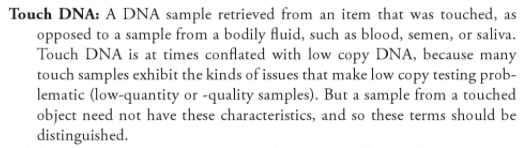
And here is NYU’s Erin Murphy providing further clarification in Inside the Cell: The Dark Side of Forensic DNA:
In turn, as I noted in a post several years ago,
Low copy number DNA allows the genetic profiles of suspects, victims or witnesses to be “uncovered” even when there is only a tiny amount of biological material present, sometimes as small as a milionth of the size of a grain of salt. The technique amplifies these tiny DNA fragments when it is believed that a suspect may have transferred DNA through touch, like the residue believed to have come from cells such as skin or sweat left in a fingerprint.
Low copy number DNA is often called “low template DNA” because it means that a scientist has worked with a sample containing less than 200 picograms* of DNA and used supra–28 cycle amplification to get a result.
The problem with this process is that, as with zooming far into a picture to try to see something…the results can get blurry. As I noted in my post,
Since this technique was launched in 1999, it has been consistently doubted in the scientific community, and it has thus only been used in the U.K., the Netherlands, and New Zealand. Nonetheless, it has found popularity in the U.K., being used 21,000 times in its nine years of existence. That popularity now looks like a pernicious mistake which should result in an avalanche of appeals by criminals who were convicted using the method.
This avalanche is likely to come as a result of the acquittal of Sean Hoey, the only man charged in connection with the Omagh car bombing.
As noted by Erin Murphy, touch DNA is often conflated with low copy number DNA, see, e.g., Commonwealth v. Treiber, but the concepts are distinct, although there is overlap. You can picture this through a Venn diagram:
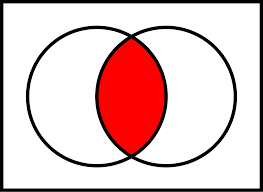
The left circle is low copy number DNA, which simply means that the sample contains less than 200 picograms of DNA. That DNA could have come from touching or a bodily fluid. The right circle is touch DNA, which simply means that the DNA sample comes from touching, rather than bodily fluid. That sample could contain more or less than 200 picograms of DNA. Finally, the red overlap** covers cases where the sample contains under 200 picograms of DNA and came from touching.
Let’s now turn to the uses of touch DNA. First, it can be used to prove a wrongful conviction by tending to establish that someone else committed the crime, as in the Timothy Masters case, the first case involving a touch DNA exoneration. Second, it can be used to crack a cold case, which is how it could be used in the John Zera case. Third, it could be used to show crime scene contamination or an alternate reason for how a suspect’s DNA ended up at a crime scene. This is the argument being made in the Steven Avery/“Making a Murder” case.
____________________
*A picogram is one trillionth of a gram.
**This overlap would be larger than what is represented in this diagram.
-CM