
Notes From the Brink of the Atomic Age: A Review of the TV Series “Manhattan”
“Sometimes the most crucial elements in a reaction are pretty much invisible. Sometimes they’re barely allowed in the building.” Theodore Sinclair, “Manhattan,” Season 1, Episode 7.
Last summer, my colleague Alex Ruskell told me I should check out the new show “Manhattan,” which was created by Sam Shaw, whom he had known from their time at the Iowa Writers’ Workshop (Shaw’s wife Lila Byock is also an Iowa alum and writer on the show). Unfortunately, as is probably the case for many people, I didn’t have WGN America, the station that carries the show. Luckily, I recently got WGN America and was able to record a season 1 marathon that aired before Season 2 premiered on October 13th. It’s quickly become my favorite show on TV.

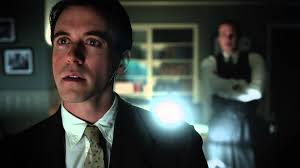
“Manhattan” is about the Manhattan Project and the attempt to create a weapon that would end all wars. John Benjamin Hickey (“The Big C”*), stars as Frank Winter, a physicist and World War I vet who has been kicked out of half of the colleges in the Ivy League. He’s the head of a motley splinter group working on an implosion atomic bomb while the well-heeled establishment team fronted by Reed Akley toils away at the gun model design. The triggering event in the series occurs in the pilot when Charlie Isaacs, a Jewish wunderkind, arrives in Los Alamos, New Mexico to work for Akley and begins a combustible relationship with Winter and his team.
Foreground: Charlie Isaacs; Background: Reed Akley
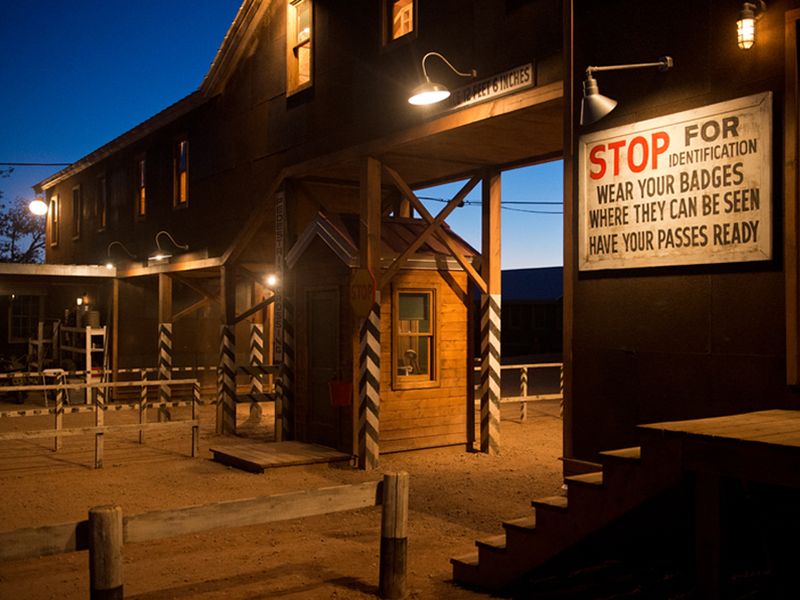
That pilot was directed by Thomas Schlamme (“The West Wing”**), who said it was influenced by Robert Altman‘s “McCabe & Mrs. Miller.”*** The comparison rings true as both involve makeshift frontier towns populated by a collection of misfits. As lensed by cinematographer Richard Rutowski (“The Americans”), Los Alamos takes on a spare life of its own, a Kafkaesque feedback loop**** illuminated by only the southwest sun and Tungsten lamps. Because there’s no wind, things don’t blow over in Los Alamos; for every action, there is an equal and opposite reaction.
The entrance to the Manhattan Project on the series
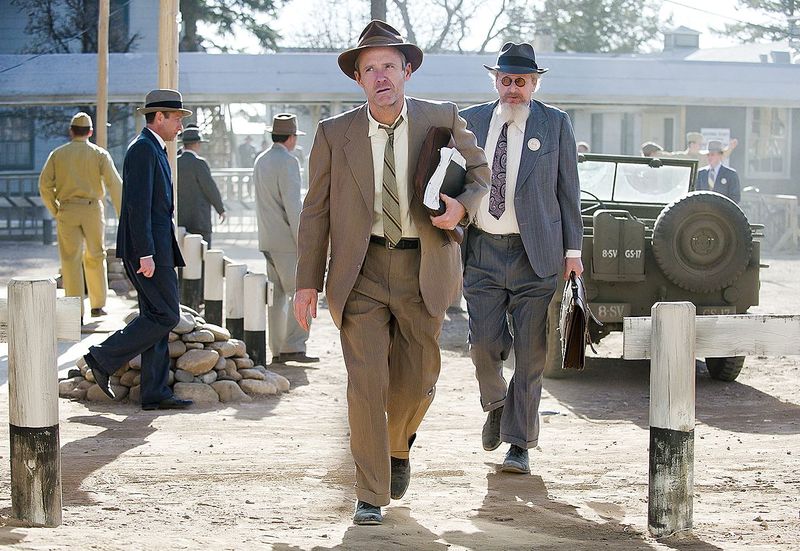
This focus on the past is personified in a government spook played by Richard Schiff, whose McCarthy-esque attempts to smoke out spies sparks a series of Faustian Bargains by the central players in the Project. The cast playing them is uniformly excellent. Hickey is the glue that holds the show together, his Frank Winter a ticking time bomb of a man who could very well atomize before his bomb. Winter’s mentor, Glen Babbit, is played with great stillness by Daniel Stern, only recognizable by his voice. And Olivia Williams (“Rushmore,” “Dollhouse”) steals every scene she’s in as Winter’s wife, a botanist trying to find her footing in a place that isn’t supposed to exist.*****
Olivia Williams as Dr. Liza Winter
The show is a largely fictionalized narrative of the Manhattan Project, with the Winter character loosely based on Seth Neddermeyer, the father of the implosion theory. I think this works to the show’s advantage because Shaw and his team have a “Mad Men”-esque ability to summon period trappings without falling into them. While the show easily could have been a static retelling of a moment in time, Shaw and company imbue the series with a dynamic energy as even typically marginzalized characters and ideas are given a voice at the dawn of the Atomic Age. As a result, the show, like the decision to build a better bomb, has reverberations that can be felt today.
John Benjamin Hickey as Frank Winter & Daniel Stern as Glen Babbit
________________________
*And recurring guest star on my second favorite show, “The Good Wife.”
**And the late, great, “Jack & Bobby.”
***My favorite Western of all time.
****The observation is first made by Winter’s daughter and later amplified when Winter tries to determine whether the radiation levels of the Project workers fall within “acceptable limits.”).
*****The show does well by its female characters, ranging from Isaacs’ wife to a working girl very much in the vein of Altman’s Mrs. Miller.
-CM