
The Hairs That Came From Neither Hae Nor Adnan: The Most Exculpatory Physical Evidence in the Case?
In yesterday’s Addendum Episode of the Undisclosed Podcast, we discussed an important piece of physical evidence: the two hairs recovered from Hae’s body and/or clothes that were determined not to be the hairs of either Adnan or Hae:
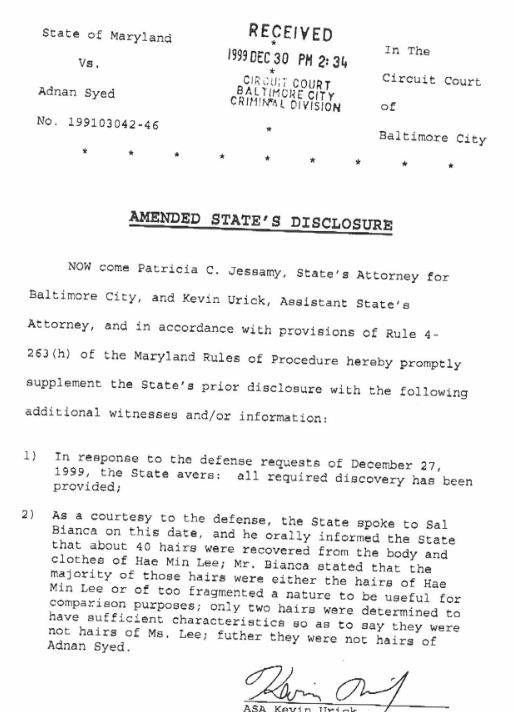
This information is hugely important, both legally and factually. As we discussed during the Addendum Episode, the hair analysis report done by Sal Bianca was first turned over to the defense on December 2, 1999, just days before Adnan’s first trial. According to that report, none of the hairs recovered from Hae’s body and clothes matched Adnan. In response, the defense immediately requested clarification of the report, specifically seeking to verify that while none of the removed hairs belonged to Adnan, they did belong to Hae. During Adnan’s first trial, however, no such clarification was given by the State.
It wasn’t until two weeks after Adnan’s first trial ended in a mistrial, on December 30, 1999, that the State disclosed that, in addition to the hairs not matching Adnan, two of the hairs recovered from Hae’s body or clothes did not match Hae’s hair. This was the Amended Disclosure posted above.
Simply put, this was a Brady violation, and it would have resulted in a new trial if Adnan’s first trial ended in a conviction rather than a mistrial. To illustrate this point, consider Hoffman v. State, 800 So.2d 174 (Fla 2001), in which the defendant was convicted of murder(s) based in part on his own confessions and a cigarette pack with his fingerprints found at the murder scene. In Hoffman, the State disclosed that a hair analysis was done but failed to disclose that a hair found in one of the victim’s hands was not a match for the defendant, his co-defendant, or the victims. According to the court, “[i]n failing to do so, the State committed a Brady violation when it did not disclose the results of the hair analysis pertaining to the defendant” because those results created the reasonable probability of a different outcome.
That’s the legal importance of the State’s late disclosure of Bianca’s findings. There was a clear Brady violation at Adnan’s first trial. Now, that violation can’t lead to a new trial because Adnan’s first trial ended in a mistrial, but it certainly can be used as circumstantial evidence in support of Adnan’s current Brady/cell tower claim.
That takes us to the factual importance of the evidence. There’s a reason that the court found the hair evidence in Hoffman was material. There, as in Adnan’s case, the presence of hair that belonged to neither the victim nor the defendant strongly points toward a third person being involved in the murder.
In Adnan’s case, who could that be? Jay claims that he never touched Hae’s body. Hae’s body was mostly covered while she was in a secluded part of Leakin Park, making it unlikely that multiple hairs came from some random person who was in that park, such as Mr. S. Could the hair have come from someone working for the State, including Sal Bianca himself? It’s always a possibility, but the likeliest scenario certainly seems to be that the hairs came from someone involved in Hae’s death or burial.
Now, it’s true that problems with hair analysis have been discovered recently. It’s important to note, though, that these flaws typically have a funny way of helping the State.
The Justice Department and FBI have formally acknowledged that nearly every examiner in an elite FBI forensic unit gave flawed testimony in almost all trials in which they offered evidence against criminal defendants over more than a two-decade period before 2000.
Of 28 examiners with the FBI Laboratory’s microscopic hair comparison unit, 26 overstated forensic matches in ways that favored prosecutors in more than 95 percent of the 268 trials reviewed so far, according to the National Association of Criminal Defense Lawyers (NACDL) and the Innocence Project, which are assisting the government with the country’s largest post-conviction review of questioned forensic evidence.
This is because hair analysis is highly subjective, and analysts frequently misidentify hairs as belonging to victims and defendants. Of course, this is not what happened here. Bianca concluded that neither Adnan nor Hae were the sources of two hairs found on Hae’s body or clothes. In the hair analysis realm, exculpatory conclusions are much more reliable than inculpatory conclusions, and Bianca’s conclusion was certainly exculpatory. In fact, it might just me the most exculpatory piece of physical evidence in the case.
-CM