
Some Quick Thoughts on the State’s Response to Adnan’s Motion to Reopen
Yesterday, the State filed its CONSOLIDATED RESPONSE IN OPPOSITION TO PETITIONER’S MOTION AND SUPPLEMENT TO REOPEN POST-CONVICTION PROCEEDINGS in the Adnan Syed case. In this post, I will give a quick take on the RESPONSE.

No “In the Interests of Justice” Cases Cited by the State
The Circuit Court will decide whether to reopen the postconviction proceeding under the standard set forth in Section 7-104 of the Maryland Code of Criminal Procedure, which states that
The court may reopen a postconviction proceeding that was previously concluded if the court determines that the action is in the interests of justice.
In his motion to reopen, Adnan’s attorney cited a few on point “in the interests of justice” cases, including (1) Campbell v. State, 376 A.2d 866 (Md.App. 1977), in which a case was reopened based upon the allegation that the prosecutor dissuaded a witness from testifying; and (2) Curry v. State, 458 A.2d 474 (Md.App. 1983), in which a case was reopened based upon the allegation that the prosecutor misstated facts to the court.
My biggest questions before reading the State’s RESPONSE were whether they would (1) try to distinguish Campbell or CurryFirst, there is no reference to either case in the State’s RESPONSE. Second, after citing two Maryland cases — Gray v. State and Harris v. State — for the general definition of the “in the interests of justice” standard, the State doesn’t cite any other cases or argue why they support denial of the motion to reopen.
No Failure to Contact an Alibi Witness Cases Cited by the State
In his motion to reopen, Adnan’s attorney cited several cases standing for the proposition that trial counsel is ineffective based upon failure to contact an alibi witness brought to her by the defendant. Two of these cases emerged from the Maryland state court system: In re Parris W. and Griffin v. Warden, Maryland Correctional Adjustment Center. The argument in the motion was that Adnan’s case was just like Parris W., Griffin, and the other cited cases save for the fact that Adnan’s alibi witness did not testify at his initial PCR hearing.
This makes sense given that there is a Maryland case — Veney v. Warden — which stands for the proposition that a witness must appear at a PCR hearing to substantiate a defendant’s claim. Unsurprisingly, this was the case relied upon by the State at the initial PCR hearing to claim that Adnan must be denied relief.
What this means is that the testimony by Adnan’s alibi witness can make all the difference in the world. The State’s argument in its RESPONSE is that,
this Court, in rejecting Syed’s claim of ineffective assistance of counsel, did not dispute that Syed’s trial attorney, M. Christina Gutierrez, declined to pursue McClain as an alibi witness. Rather, armed with essentially the same information that Syed seeks a second opportunity to present, the Court found “several reasonable strategic reasons for trial counsel’s decision to forego pursuing Ms. McClain as an alibi witness,” and properly denied Syed’s claim on the ground that counsel’s performance was not deficient based upon what Gutierrez knew at the time of her decision.
This conclusion only makes sense, however, if a court is entitled to find that an attorney can refuse to contact an alibi witness for strategic reasons. Several of the cases cited by Adnan’s attorney say that such a decision cannot be made, including Griffin, which involved the same court hearing Adnan’s motion to reopen. By way of contrast, the State’s RESPONSE does not cite to a single case in which a court has held that an attorney can choose not to contact an alibi witness for strategic reasons. As far as I can tell, none exist. Indeed, the clear lesson of Griffin is that an attorney cannot make a strategic reason to refuse to call an alibi witness at trial until after she has contacted that witness before trial.
A Defense of Kevin Urick
In his motion to reopen, Adnan’s attorney claimed that Adnan’s alibi witness failed to show up at Adnan’s initial PCR proceeding based upon a phone conversation that she had with Kevin Urick, one of the prosecutors at Adnan’s initial trial(s). In its RESPONSE, the State notes how (1) Asia was wavering before she spoke to Urick; and (2) Urick would have no reason to intentionally dissuade Asia from testifying.
From my perspective, the problem with the State’s RESPONSE is that it assumes Adnan’s attorney is arguing or needs to argue that Urick acted in bad faith or was the sole cause of Asia’s failure to appear at Adnan’s initial PCR proceeding. But no such argument is required.
I did a post about this back in May. First,”[e]ven if the prosecutor’s motives were impeccable,” relief should be granted if he unintentionally played a role in a witness’s decision not to testify. Second, a defendant “need not establish direct or exclusive causation.” In other words, as long as the prosecutor is one of the reasons that a witness decided not to testify, relief should be granted even if other reasons played a role.
Indeed, the aforementioned Campbell case is arguably a case with a prosecutor who was neither acting in bad faith nor the sole cause of a witness opting out of testifying, and the Court of Appeals of Maryland granted relief. And indeed, this entire line of precedent stems from the Supreme Court’s opinion in Webb v. Texas, in which a judge was acting in good faith but accidentally dissuaded a witness from testifying. In conclusion, the State’s focus on bad faith and exclusive causation is misguided because neither bad faith nor exclusive causation in required.
The AT&T Cover Sheet
Recently, Adnan’s attorney filed a Supplement to Motion to Re-Open Post-Conviction Proceedings, in which he sought admission of the the AT&T Cover Sheet. In its RESPONSE, the State claims that the court should not allow this evidence for two reasons.
First, the State claims that because Adnan was initially denied relief under the defective performance prong of ineffective assistance of counsel, the court should not consider the AT&T Cover Sheet, which is connected to the prejudice prong. The odd thing about this argument is that it was the State itself which invoked the prejudice prong.
In its Brief of Appellee, the State claimed, for the first time, that even if Adnan’s alibi witness testified, it could have shifted its timeline to claim that the Best Buy call was the 3:15 P.M. call on Adnan’s call log, meaning that Adnan couldn’t satisfy the prejudice prong. In large part, the Supplement was the response to this argument, with the claim being that the State had made all aspects of the 3:15 P.M. call, including which cell tower it pinged, relevant. Indeed, I called this the strongest argument in the Supplement. It’s kind of tough to argue that the court shouldn’t consider the prejudice prong when the State itself is the one who invoked that prong.
Second, the State claims that
The first page of Syed’s Exhibit 1 is an AT&T fax cover sheet, near the bottom of which is a boxed boilerplate legend titled “How to read ‘Subscriber Activity’ Reports.” This generic cover sheet accompanied all documents faxed by AT&T to the detectives in this case, whether the attached document was a Subscriber Activity report or not….
The flaw in Syed’s argument is that the cellphone records relied upon by the State’s expert and entered into evidence at trial were not Subscriber Activity reports. They had no blacked out columns; they had none of the codes discussed in the boilerplate legend; they lacked a column titled “location.” See State’s Exhibit 31. Accordingly, it is flatly erroneous to say that the statement about the reliability of incoming calls — which relates to Subscriber Activity reports — applies to the altogether different records used by the State. Indeed, the “Subscriber Activity” reports were neither identified as exhibits nor admitted into evidence. What was admitted into evidence were cellphone records accompanied by a certification of authenticity, signed by an AT&T security analyst, and relied upon by the State’s expert who himself was employed by AT&T as a radio frequency engineer.
I have a few responses. The first is confusion. The State absolutely identified “Subscriber Activity” reports as exhibits and admitted them into evidence. Here is one example:
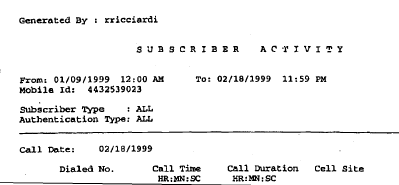
My second thought is that the fact that the cover sheet accompanied all documents faxed by AT&T helps rather than hurts the defense case because it shows that any document sent by AT&T showing incoming tower pings was unreliable for determining location.
My third thought is that I wish I had a copy of Exhibit 31 to see what the State is referencing. The State definitely did introduce AT&T “Subscriber Activity” reports at trial that were accompanied by the cover sheet in question. Is its claim that it also introduced other AT&T documents that were somehow not governed by the cover sheet which the State claims accompanied all documents sent by AT&T? It’s impossible for me to tell at this point, but I do know that the State introduced “Subscriber Activity” reports at trial, making the cover sheet relevant.
Note: I will be out of pocket from early this afternoon until Sunday night, so I probably won’t be approving and responding to comments to this post. [Update: Plans were delayed, so I will be approving and answering comments.].
-CM