
Authentication and More Thoughts on the State’s Response to Adnan’s Motion to Reopen
In its CONSOLIDATED RESPONSE IN OPPOSITION TO PETITIONER’S MOTION AND SUPPLEMENT TO REOPEN POST-CONVICTION PROCEEDINGS in the Adnan Syed case, the State made the following argument:
The flaw in Syed’s argument is that the cellphone records relied upon by the State’s expert and entered into evidence at trial were not Subscriber Activity reports. They had no blacked out columns; they had none of the codes discussed in the boilerplate legend; they lacked a column titled “location.” See State’s Exhibit 31. Accordingly, it is flatly erroneous to say that the statement about the reliability of incoming calls — which relates to Subscriber Activity reports — applies to the altogether different records used by the State. Indeed, the “Subscriber Activity” reports were neither identified as exhibits nor admitted into evidence. What was admitted into evidence were cellphone records accompanied by a certification of authenticity, signed by an AT&T security analyst, and relied upon by the State’s expert who himself was employed by AT&T as a radio frequency engineer.
In this post, I will discuss the concept of authenticity/authentication as it relates to the cell tower and forensic evidence in the case.
Authentication is the process by which a party asserts that an exhibit demonstrates “X” and then establishes that the exhibit does in fact demonstrate “X.” For instance, imagine that defense counsel wants to introduce what it claims to be a confession letter written by an alternate suspect. Defense counsel would need to proffer that letter as a confession letter written by the alternate suspect and then present sufficient evidence (e.g., testimony by (1) a handwriting expert or (2) someone familiar with the alternate suspect’s handwriting) to have the the letter authenticated so that the judge could decide whether the letter satisfies the rules of evidence and will be admissible.
Under federal law, authentication is covered by Federal Rule of Evidence 901(a), which provides that
To satisfy the requirement of authenticating or identifying an item of evidence, the proponent must produce evidence sufficient to support a finding that the item is what the proponent claims it is.
In turn Federal Rule of Evidence 901(b) provides several illustrations of ways in which the authentication test can be satisfied through extrinsic evidence. In the example above, testimony by a handwriting expert would satisfy Rule 901(b)(3) while testimony by someone familiar with the alternate suspect’s handwriting would satisfy Rule 901(b)(2). Additionally, Federal Rule of Evidence 902 allows for the self-authentication of certain exhibits, which means that no extrinsic evidence needs to be presented to establish authenticity. For instance, Federal Rule of Evidence 902(6) allows for the self-authentication of “[p]rinted material purporting to be a newspaper or periodical.”
Importantly, authentication does not in any way establish the reliability of the contents of the exhibit. For instance, under Rule 902(6), an article from the National Enquirer would be self-authenticating, but the contents of that article would not be reliable, for obvious reasons. Similarly, a certified copy of polygraph test results would be self-authenticating under Federal Rule of Evidence 902(4), but the results themselves would be neither (legally) reliable nor admissible.
In this sense, I’m not sure what distinction the State is trying to make in its RESPONSE. It seemingly acknowledges that Exhibit 31 was accompanied by the AT&T cover sheet about incoming calls being unreliable for determining location and yet cites to the certification of authenticity as if that certification could solve the reliability problem. The problem for the State is that it can’t. The certificate of authenticity merely tends to establish that Exhibit 31 consisted of cell phone records, not that the records of incoming calls are reliable for determining location, at least with regard to incoming calls.
This takes me to the forensic evidence in the case. This is from the testimony by Dr. William C. Rodriguez, who was in charge of disinterring Hae Min Lee (page 159):
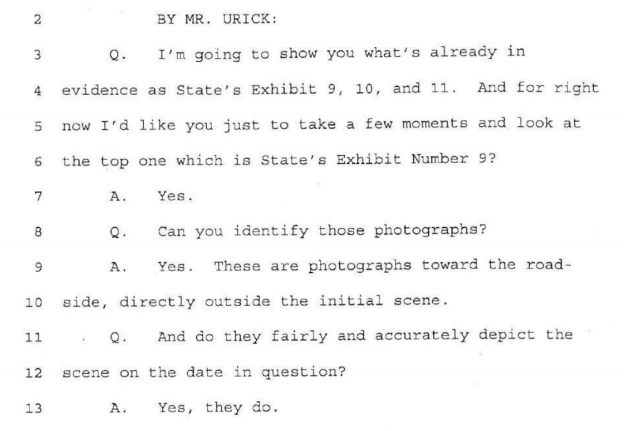
This is how photographs are authenticated: A witness who was present when the photos were taken testifies that they fairly and accurately depict the scene on the date in question. As his testimony progresses, Dr. Rodriguez subsequently provides further authentication of specific photographs and what they depict.
As we noted in our appearance on The Docket, the State did not turn over all of the crime scene photographs in its file to MSNBC/us. What it did turn over, as far as we know. is every authenticated crime scene photograph that was authenticated and admitted into evidence. There were eight of them.
When the medical examiner on Episode 5 of Undisclosed concluded that lividity was inconsistent with Hae Min Lee being (1) pretzeled up in the trunk of her Sentra for 4-5 hours after death; and (2) buried in Leakin Park in the 7:00 P.M. hour, she was relying upon trial testimony, autopsy photos, and the autopsy report. When, as I reported on the Labor Day minisode, the medical examiner reached these same conclusions, she was also relying upon the eight crime scene photos which were authenticated and admitted as State’s exhibits at trial. In other words, the medical expert reached her conclusions based upon all of the evidence that satisfied the authentication requirement and the other rules of evidence.
-CM