
The U.S.-U.K. Extradition Treaty, the Doctrine of “Dual Criminality,” and the Detention of Adnan Syed
Over the last few days, I’ve been going more in depth into the issues surrounding the denial of bail to Adnan Syed. In particular, I’ve posted eleven of the bail letters submitted by Adnan’s fellow Woodlawn students in support of his pre-trial release. In today’s post, I want to focus on one of the legal issues surrounding the detention decision.
As part of the bail package presented by Adnan’s lawyers, Adnan agreed to do two things in addition to posting collateral and submitting to electronic monitoring/house arrest. First, he agreed to turn in his passport.
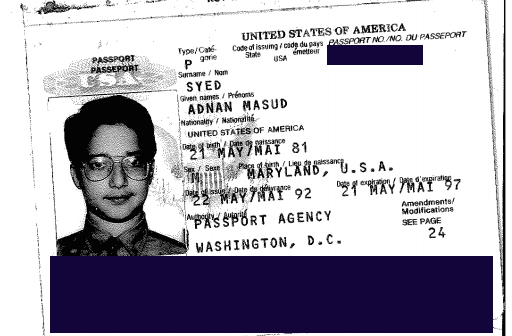
Two things are clear from the passport: (1) Adnan’s birth date of May 21, 1981, establishing his ineligibility for the death penalty; and (2) the May 21, 1997 expiration of the passport, meaning that it had been expired for nearly two years before his arrest.
Second, Adnan agreed to sign an Irrevocable Waiver of Extradition:
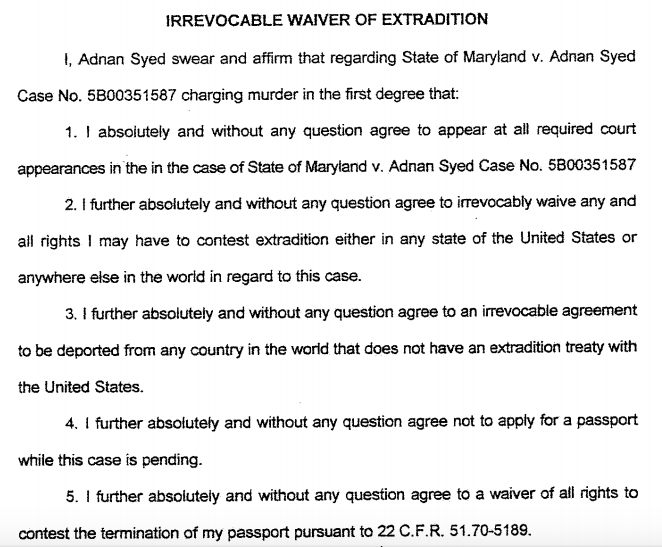
In other words, even though his passport had been expired for about two years, if Adnan, a U.S. citizen, somehow fled to Pakistan despite electronic monitoring, he agreed to extradition to the United States for his trial.
According to Vicki Wash, these proffers weren’t good enough because a number of young students who had been jilted committed murder and then fled to Pakistan, creating extradition issues. Wash later apologized for mischaracterizing the information she had received on this issue:

So, were there (m)any murder cases that had led to extradition issues with Pakistan? I doubt it.
Extradition between the United States and the Islamic Republic of Pakistan is governed by the terms of the 1931 U.S.-U.K. Extradition Treaty. 47 Stat. 2122….The treaty applies to Pakistan through its former colonial sovereign, the United Kingdom; as the Pakistani magistrate noted, Pakistan has notified its consent to the treaty. United States v. Bokhari, 757 F.3d 664, 661 n.1 (7th Cir. 2014)
Under this treaty, there can be extradition only if the doctrine of “dual criminality” is satisfied, i.e, if the crime charged is a crime in both the United States and Pakistan. This has created issues in certain cases. For instance, in United States v. Khan, 993 F.2d 1368 (9th Cir. 1993) the doctrine wasn’t triggered because there was no Pakistani crime analogous to the United States crime of using a telephone to facilitate the commission of a drug felony. Similarly, the court in Bokhari noted that “Pakistan has not extradited a fugitive to this country in a fraud-related matter since 1984.”
Conversely, murder is, of course, a crime in Pakistan, thus triggering the doctrine of “dual criminality.” If I had to guess, the cases referenced by Wash were cases involving crimes under U.S. law that are not also crimes under Pakistani law. As such, they would have no relevance to Adnan’s case.
-CM