
Is Cristina Gutierrez Responsible for the Death Penalty in Puerto Rico?
Back in June, I did a post about a memo to Cristina Gutierrez about how another client was being billed for work done in Adnan’s case. That memo was dated September 16, 1999, and the other client was Hector Oscar Acosta-Martinez. I was reminded of this fact when I came across this letter from the following week while reviewing the bail issues in Adnan’s case:
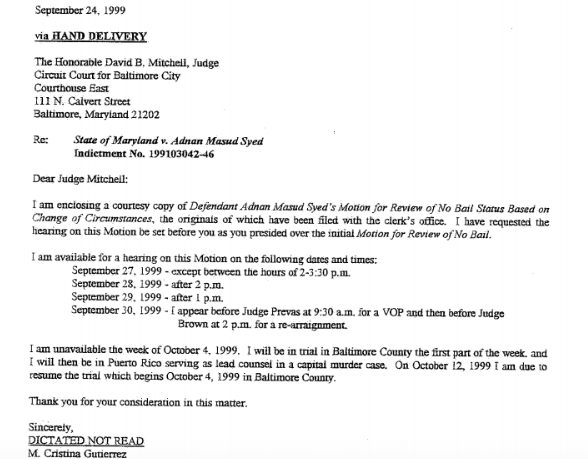
The Puerto Rico case was the Acosta-Martinez case, and the big question in that case was whether the Federal Death Penalty Act (FDPA) applies in Puerto Rico. In United States v. Acosta-Martinez, 106 F.Supp.2d 311 (D. Puerto Rico 2000), the court ruled that it did not. Its reasons were two-fold. First,
(1) the purpose of establishing Commonwealth status in Puerto Rico was to develop and enhance self-government by the people of Puerto Rico and create an autonomous political entity; (2) in voting to accept Public Law 600-adopted by Congress as a compact with the people of Puerto Rico-the people of Puerto Rico accepted section 9 of the [Puerto Rican Federal Relations Act (PRFRA)], which provides for the applicability to the Commonwealth of all Federal law if not locally inapplicableexpressly prohibits capital punishment in Puerto Ricorepugnant to the death penaltyis locally inapplicable within the meaning of section 9 of the PRFRA.
Second, the court held that it violated substantive due process to impose the death penalty on Puerto Ricans despite the fact that they are denied the right to vote:
It shocks the conscience to impose the ultimate penalty, death, upon American citizens who are denied the right to participate directly or indirectly in the government that enacts and authorizes the imposition of such punishment. It is unconscionable and against the most basic notion of justice to permit that the American citizens of Puerto Rico be subjected to capital punishment for crimes committed wholly within the boundaries of the Commonwealth, while at the same time denying them a say in the political process of the government that tries them. If the qualitative difference of the death penalty has been sufficient to require more reliable procedures for its imposition, it certainly ought to be sufficient to require that its availability as punishment be grounded, in its origin, on the consent of those whose rights may be affected by its imposition, such consent expressed through their participation in the political process as a manifestation of their free will.
The Department of Justice later appealed this ruling, and the First Circuit agreed with it that the Federal Death Penalty Act applied to Puerto Ricans in United States v. Acosta-Martinez, 252 F.3d 13 (1st Cir. 2001). Notably, at the time of this opinion, Gutierrez had been replaced as Acosta-Martinez’s attorney. Here are the relevant docket entries:
| 03/28/2001 |
DEFAULT ORDER FILED. AS APPELLEE HECTOR ACOSTA-MARTINEZ HAS FAILED TO FILE HIS BRIEF, HE WILL NOT BE HEARD AT ORAL ARGUMENT EXCEPT BY PERMISSION OF THE COURT. THE US’S REPLY TO THE BRIEF OF APPELLEE JOEL RIVERA-ALEJANDRO IS DUE ON OR BEFORE 4/11/01. [548117-1] [00-2088], SETTING BRIEFING SCHEDULE: (SU) |
| 04/02/2001 | PUBLIC NOTE: ATY. GUTIERREZ’S COPY OF THE 3/28/01 DEFAULT ORDER RETURNED FROM FEDEX “REFUSED – CO GOING OUT OF BUSINESS.” NO FORWARDING INFORMATION SUPPLIED. [00-2088] (SU) |
| 04/09/2001 | INVOLVEMENT OF ATTORNEY M. CRISTINA GUTIERREZ FOR HECTOR OSCAR ACOSTA-MARTINEZ TERMINATED. [00-2088] (SU) |
| 04/19/2001 | ORDER FILED BY JUDGE SANDRA L. LYNCH. UPON CONSIDERATION OF MOTION, LEAVE IS GRANTED APPELLEE HECTOR ACOSTA-MARTINEZ TO ADOPT THE BRIEFS OF CO-APPELLEE JOEL RIVERA ALEJANDRO AND THE AMICI CURIAE PARTIES. IN ACCORDANCE WITH THE ORDER ENTERED ON 4/6/01, APPELLEE HECTOR ACOSTA-MARTINEZ’S BRIEF MUST BE RECEIVED BY THIS COURT ON OR BEFORE APRIL 25, 2001. [00-2088] (SU) |
I think these entries pretty well explain the situation. Acosta-Martinez’s appellate brief was due in March 2001. Gutierrez failed to file this brief. When the default order was sent to Gutierrez’s office, it was refused. Gutierrez’s representation of Acosta-Martinez was thereafter terminated, and a new attorney was brought in at the last second. Understandably, all that attorney could do was adopt the existing briefs. As a result, the lead defendant in the case did not have his own brief.
Would the First Circuit have reversed if Gutierrez had been on the ball? It’s impossible to know, but what we do know is that her arguments had been successful with the trial court and that she never made her arguments to the appellate court.
Those who have listened to Episode 10 of Serial might recall a very similar scenario playing out in the Zachary Witman case. In that case, Gutierrez won a key suppression motion in 1999. Then, due to some errors that I will be addressing later, an appellate court reversed that order in early 2000. Witman’s cert petition to the United States Supreme Court was then due on March 20, 2001. Gutierrez, however, lied about consulting a law professor about the petition, never submitted it, and the last-second petition filed by Witman’s new attorney was not granted.
So, what can the the Acosta-Martinez and Witman cases tell us about Gutierrez’s representation of Adnan? I’ll delve more into the details of the Witman case in a future episode. What I find interesting, though, is that Gutierrez was handling three first-degree murder cases in three different jurisdictions in 1999/2000: (1) Adnan/Maryland/; (2) Witman/Pennsylvania; (3) Acosta-Martinez/Puerto Rico & Federal. I’m not sure that this simultaneous representation is unprecedented, but I have to think it’s exceedingly rare for an attorney to be handling three different murder cases in three jurisdictions at the same time. We know that she dropped the ball in at least two of those cases. Many would argue that she also dropped the ball in the third.
-CM