
Did Gutierrez Give Ineffective Assistance of Counsel to Adnan on the Lividity Issue?
I just got the following question from Alison Sweeney:
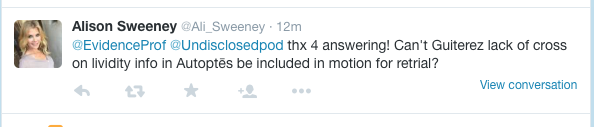
It’s a very good question and one that has an answer I recently uncovered.
Just a few months ago, the United States District Court for the District of Maryland decided Nicolas v. Attorney General of Maryland, 2015 WL 1469184 (D.Md. 2015). In Nicolas, the defendant appealed his murder conviction, claiming that the state courts in Maryland erred by rejecting his argument that
his trial counsel provided ineffective assistance by failing to become sufficiently educated about lividity evidence and by failing to rebut the state’s expert at trial.
Specifically, the defendant’s trial was held in the same court as Adnan’s trial, and the medical examiner “testified that lividity could become fixed within two hours.” This was obviously wrong, but the court found that his attorney’s failure to properly cross-examine the medical examiner or call/consult his own wasn’t the type of error that can really support a finding of ineffective assistance. According to the court.
In [Harrington v. Richter], the Supreme Court noted: “Rare are the situations in which the wide latitude counsel must have in making tactical decisions will be limited to any one technique or approach. It can be assumed that in some cases counsel would be deemed ineffective for failing to consult or rely on experts, but even that formulation is sufficiently general that state courts would have wide latitude in applying it.” Harrington, 562 U.S. at 106…; Hudson v. Lafler,…(denying ineffective assistance claim in § 2254 petition based upon counsel’s alleged failure to adequately challenge prosecution’s gunshot residue expert or to obtain an independent gunshot residue expert).
Therefore, according to the court, the State of Maryland properly exercised its discretion in denying the defendant’s claim of ineffective assistance.
So, to answer Alison’s question: (1) Adnan can’t raise the lividity argument as part of his claim that he received the ineffective assistance of counsel because he didn’t raise it before; and (2) he likely didn’t raise it before because his attorney was aware that it wasn’t a viable argument in Maryland. In other words, Gutierrez’s failures on the lividity issue were important but, unfortunately, not significant enough to lead to a new trial.
-CM