
Some Thoughts on the State’s Brief in the Adnan Syed Case
Yesterday, the State of Maryland filed its Brief of Appellee in Syed v. State. In this post, I will list my thoughts about the State’s arguments on Adnan’s claim that he received the ineffective assistance of counsel based upon his trial attorney’s failure to contact Asia McClain, a potential alibi witness.*
Let’s start by reviewing the gist of Adnan’s claim: Adnan was arrested on February 28, 1999 for murdering his ex-girlfriend, Hae Min Lee, on January 13, 1999. On March 1 and 2nd, 1999, Asia McClain sent Adnan letters in jail indicating that she remembered seeing him in the library on January 13, 1999. Adnan passed these letters along to his attorney and her clerk, but Asia was not called as a witness at trial. After Adnan was convicted, Rabia Chaudry contacted Asia, who signed an affidavit indicating that: (1) she recalled seeing Adnan in the library until 2:40 P.M. on January 13, 1999; and (2) no attorney had contacted her in connection with the case. In 2012, the Baltimore City Circuit Court held a hearing on Adnan’s Petition for Postconviction Relief. Asia did not testify at this hearing, and the court denied Adnan postconviction relief. On January 13, 2015, Asia signed a new affidavit, alleging that (1) Kevin Urick, a prosecutor from Adnan’s trial(s), dissuaded her from testifying at the hearing; and (2) contrary to Urick’s testimony at the hearing, she was not pressured into writing her original affidavit. Adnan’s attorney thereafter used this new affidavit as the basis for a Supplement to his motion for leave to appeal, claiming that, despite the fact that the new affidavit wasn’t part of the hearing, it should be the basis for remanding to the Circuit Court for additional factfinding in the “interests of justice.”
Now, let’s look at the various arguments the State made in its Brief of Appellee:
The Court of Special Appeals of Maryland Shouldn’t Remand
As noted, Adnan’s attorney argued that the case should be remanded in the “interests of justice.” As support, his attorney cited (1) Maryland Rule 8-204(f)(4), which allows for such remand; (2) Maryland Rule 8-604, an analogous provision with more precedent interpreting it; and (3) several cases decided by the Court of Appeals of Maryland and the Court of Special Appeals of Maryland supporting remand in Adnan’s case. In essence, the claim was that remand was appropriate if there was reason to believe that Urick might have (1) dissuaded Asia from testifying at the hearing; and/or (2) misrepresented what Asia told him when testifying at the hearing. I discussed a few of the cases supporting this claim in this post.
In yesterday’s brief, the State responded to these arguments in a single footnote (page 25):

I worked for two years as an appellate court attorney at the New York Supreme Court, Appellate Division, which, like the Court of Special Appeals of Maryland, is an intermediate appellate court. In those 2+ years, I handled approximately 200 appeals. I can’t remember a single case in which there such a trite response to an argument made in the opposing party’s filings.
There’s no discussion of the “interests of justice” standard. There’s no citation to the relevant Maryland Rules. There’s no analysis of the cases cited by Adnan’s attorney or any counter-precedent provided by the State. There’s also not even an argument made by the State. They simply claim, “Nor should this case be remanded because of McClain’s new affidavit.”
What’s even odder is that this footnote comes immediately after the State dismisses the numerous cases cited by Adnan’s attorney by claiming that

In other words, the State is (1) claiming that Adnan’s claim must fail because Asia didn’t testify at the hearing; and (2) acknowledging that Asia’s affidavit contains both “troubling accusations” and “a willingness to testify.” Isn’t that exactly why the court should remand?
Precedent Cited by the State
I’ve previously posted about precedent from across the country, including Maryland precedent, standing for the proposition that “[o]nce a defendant identifies potential alibi witnesses, it is unreasonable not to make some effort to contact them to ascertain whether their testimony would aid the defense.” I was skeptical about whether the State would be able to find even one case that cut against this proposition.
Well, the State did in fact cite to one case: State v. Lloyd, 48 Md.App. 535, 540 (Md.App. 1981), which it cited for the proposition that “the decision whether to call a witness is ordinarily a matter of trial tactics within the discretion of defense counsel.” There are two serious problems with this case.
First, the State did a nice job in its brief (page 29) of noting that two of the cases cited by Adnan’s attorney in support of Adnan’s claim that his attorney was ineffective for failing to seek a plea deal “pre-date Lafler and Frye, the two Supreme Court decisions that clarified the constitutional obligations of counsel in this context….” I fully agree with this point, and it’s part of why I think Adnan will have difficulty winning that claim.
The problem for the State is that the same reasoning applies to Lloyd. Lloyd was repudiated by the Court of Appeals of Maryland in State v. Tichnell, 509 A.2d 1179 (Md. 1986), because it applied a Maryland test for ineffective assistance of counsel claims that pre-dated the opinion by the United States Supreme Court in Strickland v. Washington. In Tichnell, the Court of Appeals of Maryland reversed the ruling of a postconviction court because
the post conviction court, while citing Strickland, made no analysis of the constitutional standards set forth in that case for determining whether counsel rendered ineffective assistance to Tichnell. Instead, it relied upon the pre-Strickland cases of Ward v. State…and State v. Lloyd… as containing the law applicable to Tichnell’s claim of ineffective assistance of counsel.
Second, even if Lloyd were still good law, it would be completely inapposite to Adnan’s claim. In Lloyd, the court found that failure to call an alibi witness was not ineffective assistance because the defendant admitted his guilt to his attorney, meaning that the attorney could not call an alibi witness because he would be suborning perjury. Indeed, in footnote 4 of its brief, the State even cites Lloyd for this proposition. This makes Lloyd completely irrelevant because the State itself acknowledges (page 16) that “[t]he undisputed evidence before the post-conviction court was that Syed had always maintained his innocence.”
Precedent Cited by Adnan’s Attorney
As noted above, the State mostly distinguished the cases cited by Adnan’s attorney simply by noting that those cases invoked alibi witness testimony, whereas Asia didn’t testify at Adnan’s hearing (pages 24-25). In this sense, the State has kind of painted itself into a corner should the Court of Special Appeals remand so that Asia can testify.
The State did make an additional attempt to distinguish Griffin v. Warden, Maryland Correctional Adjustment Center, 970 F.2d 1355 (4th Cir. 1992), which I have previously noted is the most important precedent in this case. According to the State (page 22),
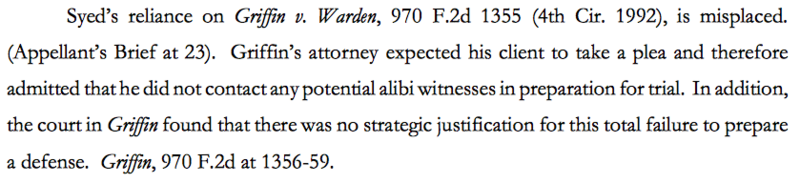
I agree with the State’s first point. In Griffin, Griffin’s attorney admitted that he did not contact potential alibi witnesses while we have to rely on Asia’s affidavit to conclude that Adnan’s trial attorney didn’t contact her. Hopefully, that affidavit can soon be supplemented by her testimony.
The second point, however, is much more interesting. You see, the court in Griffin didn’t find a lack of possible strategic justification for failing to contact alibi witnesses; it found that there couldn’t be a strategic justification for failure to contact alibi witnesses. In Griffin, the Baltimore City Circuit Court found that defense counsel might not have contacted alibi witness Rodney Staples because one of the security guards from the store that was robbed picked him out of a photo array. In reversing, the Fourth Circuit concluded that
This reasoning is thoroughly disingenuous. [Defense counsel] did not even talk to Staples, let alone make some strategic decision not to call him. Strickland and its progeny certainly teach indulgence of the on-the-spot decisions of defense attorneys. On the other hand, courts should not conjure up tactical decisions an attorney could have made, but plainly did not. The illogic of this “approach” is pellucidly depicted by this case, where the attorney’s incompetent performance deprived him of the opportunity to even make a tactical decision about putting Staples on the stand.
I don’t see how the State argues its way out of Griffin because its holding seems clear: a court can’t hypothesize strategic reasons for defense counsel’s failure to present an alibi witness at trial when the attorney never even contacted that alibi witness. In other words, the decision not to call an alibi witness can’t be made until the alibi witness is contacted.
That leaves one final case that the State couldn’t wave away, and it’s another huge one: In re Parris W., 770 A.2d 202 (Md. 2001), decided by the Court of Appeals of Maryland. The problem for the State is that Maryland’s highest court did find that the defendant in Parris received ineffective assistance despite there merely being proffers, and not testimony, by his alibi witnesses. The State tried to distinguish Parris because it was resolved on direct appeal and not resolved on postconviction (collateral) appeal. To the extent that this distinction matters, it still leads to the same place: Assuming that the court does remand so that Asia can testify, the State has done nothing to factually distinguish an important decision, in this case a decision by Maryland’s highest court.
Adnan Said He Stayed at School Until Track Practice Began
This is the big one. As noted above, in Griffin, the Fourth Circuit found that it was improper for a court (the same court that handled Adnan’s appeal) to hypothesize strategic reasons for failure to call an alibi witness who was never contacted. That said, the Baltimore City Circuit Court did hypothesize three strategic reasons in Adnan’s case. By far the “best” of these reasons was that Asia McClain contradicted Adnan’s “own stated alibi that he remained on the school campus from 2:15 p.m. to 3:30 p.m.” (page 11). I put “best” in quotes because the library was .01 miles away from Woodlawn High School, on the same road.
That said, the Circuit Court treated the school campus and the library as two meaningfully different things, which makes it important to determine the basis for the court’s conclusion. Any experienced attorney can spot the problem with the State’s alleged support for this conclusion in its Brief of Appellee (page 21):
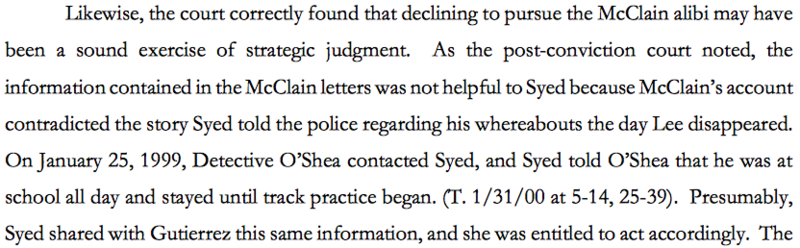
The problem is that, when a party cites broadly to 25 pages of testimony, none of those pages likely support the party’s proposition. In this case, pages 5-14 in the January 31st transcript contain unrelated testimony by Officer Adcock. Pages 25-39 do contain testimony by Detective O’Shea, but he never testifies that Adnan told him he remained at school until track practice began. Here’s the most relevant portion of his Q&A (pages 25-26):
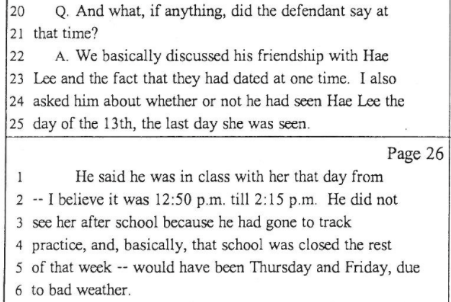
As you can see, there’s no mention of Adnan staying at school until the start of track practice. O’Shea also didn’t make this claim when testifying at Adnan’s first trial. Most importantly, O’Shea didn’t make this claim in his report of his conversation with Adnan:
On 01/25/99 the assigned went to Adnan Syed’s residence and I was informed by a woman that Adnan was in school. I received a phone call from Adnan later that day. Adnan said he was in class with Hae Lee on 01/13/99 from 1250 to 1415 hours. Adnan went to track practice after school and he did not see Hae Lee leave. Adnan said school was closed due to bad weather on 01/14 and 01/15.
In his Brief of Appellant (pages 21-22), Adnan’s attorney speculated that the Circuit Court might have reached its conclusion about Asia contradicting Adnan’s own stated alibi based upon Adnan’s alibi notice. As such, he cited to several cases standing for the proposition that alibi notices are merely discovery tools and not relevant evidence of the defendant’s version of events. Interestingly, the State doesn’t disagree in its Brief of Appellee (page 21):
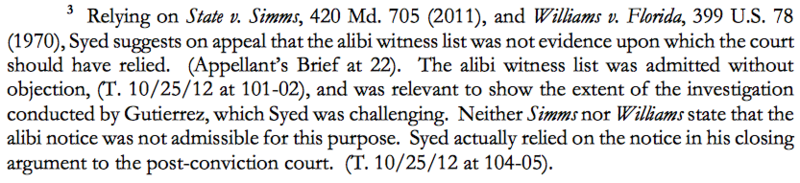
So, according to the State, the alibi notice was not used to show Adnan’s version of events; it was used to show the extent of the investigation by his trial attorney. Therefore, there was no evidence that Adnan ever claimed he remained on the school campus until the start of track practice.
In its Brief of Appellee (page 22), however, the State also tried to claim that there was
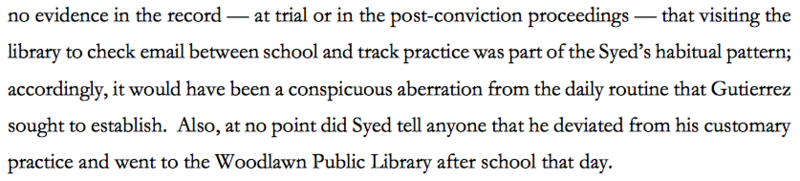
I have two issues with this statement. First, this comes from Appellant’s Exhibit 4, which are notes that Adnan’s trial attorney took after talking with him:
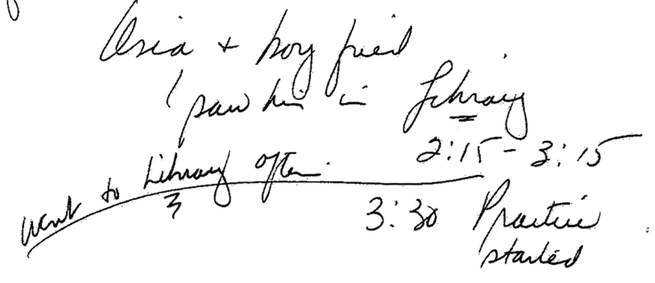
Adnan’s trial attorney not only notes (and underlines) Adnan’s claim that he went to the library often; she also does it in the same notes dealing with the Asia letters. Second, this comes from Appellant’s Exhibit 3, which are notes that were taken by a law clerk for Adnan’s trial attorney after talking with Adnan:
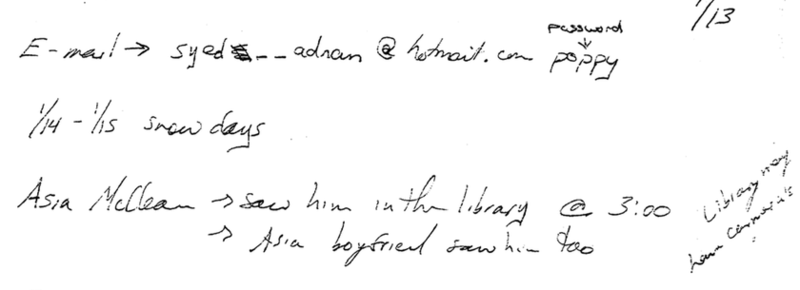
To me, this reads pretty clearly as Adnan telling the clerk that he was checking his e-mail on January 13, 1999 (the day before snow days on January 14th and 15th), when Asia and her boyfriend saw him at the library. But you don’t have to take my word for it. In its Brief of Appellee (page 20), the State acknowledges the clerk’s notes and speculates that Adnan’s trial counsel could have logged into Adnan’s e-mail account to evaluate the potential alibi. But the prosecution can’t have it both ways. Either Adnan told the clerk that he went to the library to check his e-mail, and the e-mail could have been used to check the alibi, or Adnan didn’t tell the clerk that he went to the library. I think the above note is pretty clear, which feeds us into the next point.
Adnan’s Trial Attorney Likely Checked Into Asia McClain
I discussed this above when I mentioned Adnan’s alibi notice. That alibi notice listed 80 potential alibi witnesses. According to the State (page 20-21):
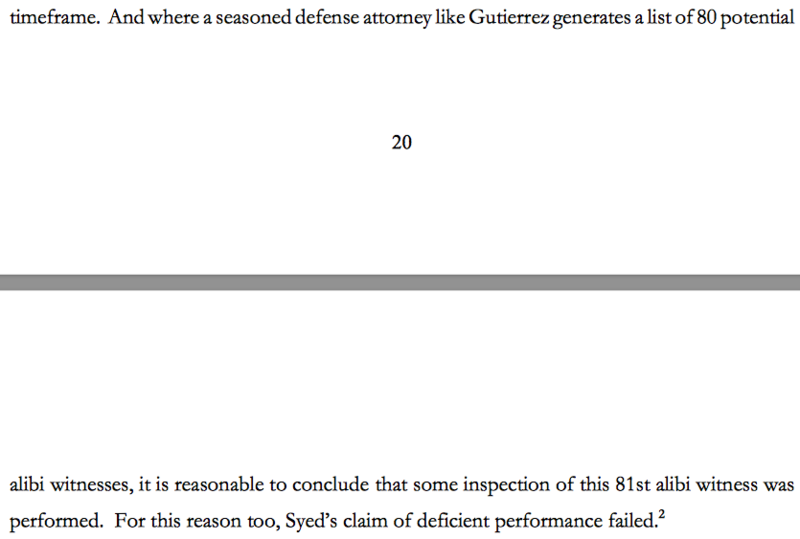
This reasoning is contradicted by black letter evidence law. As noted above, the State claimed that Adnan’s alibi notice was relevant to show the extent of the investigation conducted by his trial attorney. In other words, the State used the alibi notice as a business record under Maryland’s counterpart to Federal Rule of Evidence 803(6) to show defense counsel’s regularly conducted activity. What’s also clear is that the alibi notice included plenty of potential alibi witnesses whom Adnan’s trial attorney ruled out. Indeed, Adnan’s trial attorney apparently ruled out almost all of these alibi witnesses because the only alibi witness called was Adnan’s father.
Federal Rule of Evidence 803(6) has a counterpart: Federal Rule of Evidence 803(7). Rule 803(7) says that evidence that a matter was not included in a business record is evidence relevant to prove “that the matter did not occur or exist.” If Adnan’s trial attorney included 70+ prospective alibi witnesses whom she ruled out on the alibi notice, Asia’s non-inclusion on the list is relevant evidence that Asia was not contacted or investigated.
That leaves the State’s claim that someone on the defense team might have logged into Adnan’s Hotmail account in 1999 and somehow been able to conclusively determine that Adnan did not log into his e-mail account on the afternoon of January 13th. I don’t even see how that’s remotely possible, but I will leave it to the IT folks to address this claim.
The State also did try to argue that (1) Adnan’s trial attorney should be credited with apparently contacting 80 alibi witnesses; and (2) Asia might have contradicted the claims made by these other alibi witnesses (page 21). These arguments, however, don’t hold water. Each of the witnesses identified in the alibi notice were witnesses who attended Adnan’s Mosque** while Asia would have testified that she saw Adnan between school and track practice, which is when the State claimed that Adnan killed Hae. Moreover, Adnan’s trial attorney must have known this because, even though Asia’s letters didn’t list times, the above notes make clear that Adnan ascribed time frames for when Asia saw him at the library (2:15-3:15 and 3:00).
Therefore, Asia was the most important witness for Adnan’s trial attorney to contact, and there was no alibi witness whom could have been contradicted by her testimony. Instead, what seems clear is that Asia was not included in Adnan’s alibi notice because Adnan’s trial attorney lied to Adnan about contacting her, not because Asia’s story contradicted Adnan’s story.
Asia is Lacking in Credibility
The State spends a decent portion of its brief calling into question whether Asia would have given credible testimony at trial. My response to most of these claims is that this is exactly why the case needs to be remanded. People can, and have, reached all sorts of different conclusions based upon Asia’s letters and affidavits. The only way to sort these out is to actually have her testify and be subjected to cross-examination.
I did, however, want to point out one argument by the State that I found to be disingenuous. According to the State (page 19), at the
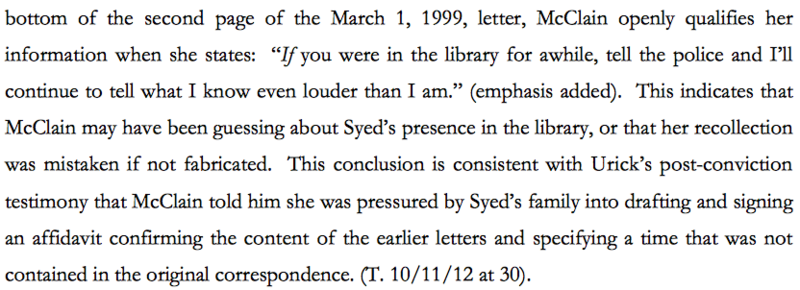
Here’s Asia’s March 1st letter. In it, she’s quite certain that she saw Adnan in the library on January 13th:
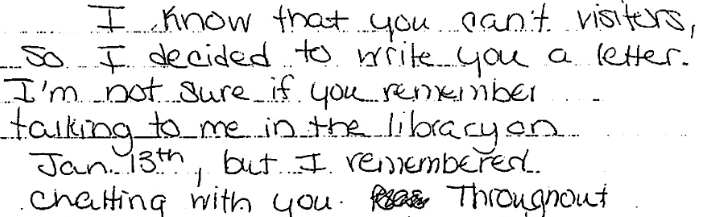
Asia’s uncertainty is clearly over the issue of how much time Adnan spent in the library, not the issue of whether he was in the library. The only thing lending itself toward the opposite conclusion is the testimony by Urick…which, yet again, is why the court needs to remand.
Adnan Failed to Prove Prejudice
According to the State, despite the fact that it claimed that Adnan had killed Hae at Best Buy by 2:36 P.M., which is when he called Jay, Adnan failed to prove that Asia’s testimony about seeing Adnan in the library until 2:40 P.M. would have created the reasonable probability of a different outcome at trial. Specifically, the State asserted that (page 26)
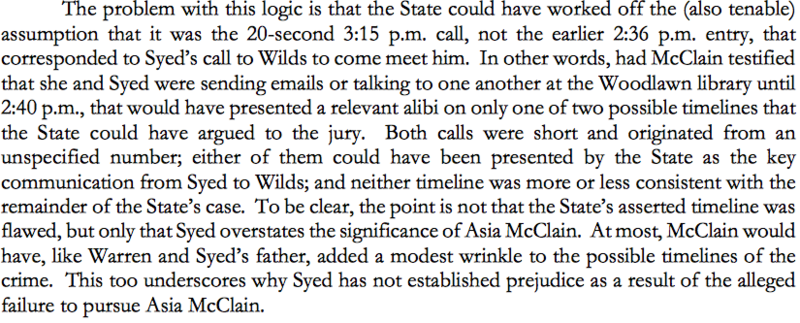
The problem with logic is that it does show that the State’s asserted timeline was flawed. If the State had presented any evidence that the Best Buy call occurred at 2:36 P.M., it couldn’t have shifted its timeline to claim that the Best Buy call occurred at 3:15.
Beyond this, there are four additional problems for the State. The first is that the uncertainty surrounding the time of the crime hurts its case. Let’s take another look at In re Parris W., decided by the Maryland Court of Appeals. Like in Adnan’s case, there was a lack of certainty/evidence about the time of the crime charged: “At the adjudicatory hearing, the State never established the time at which the assault on [the victim] occurred, although the parties seem to have assumed that it occurred at 3:45 p.m.” The key alibi witness who wasn’t called in In re Parris W. was Diane Cary, and, according to Maryland’s highest court,
Given the distance between Ms. Cary’s home and the place where [the victim] was assaulted, and given the uncertainty surrounding the time of the assault, Ms. Cary’s testimony alone may have been enough to create reasonable doubt in the mind of the hearing judge had she been available to testify.
In other words, uncertainty regarding the time of a crime makes it easier for a defendant to create reasonable doubt through an alibi witness because that witness only needs to cover some time period when the crime might have occurred.
Second, the timing of the Best Buy call is much less important than the testimony of witnesses about Hae leaving school on January 13th. A witness for the prosecution — Inez Butler — testified that she saw Hae leaving school in a hurry between 2:15 and 2:20. Similarly, a defense witness — Becky — testified that she saw Hae a few seconds after class, with Hae heading to the door that led to her car and saying that she had to leave because she had somewhere to be after school.
Was there a Best Buy call? If so, did it occur at 2:36 or 3:15? These are important questions, but, if Hae left school in a hurry between 2:15 and 2:20, Asia seeing Adnan in the library until 2_40=reasonable doubt.
The State tries to address this second problem by raising the specter of Debbie, the witness whom they wrote out of the timeline at trial. The State notes (page 25) that Debbie testified at trial that she saw Hae at school at 3:00 P.M. on January 13th. According to the State, if Debbie wasn’t enough to create reasonable doubt, then an additional witness disrupting its timeline also wouldn’t have been sufficient. This leads to the State’s third problem. This is from the State’s closing argument (page 54):
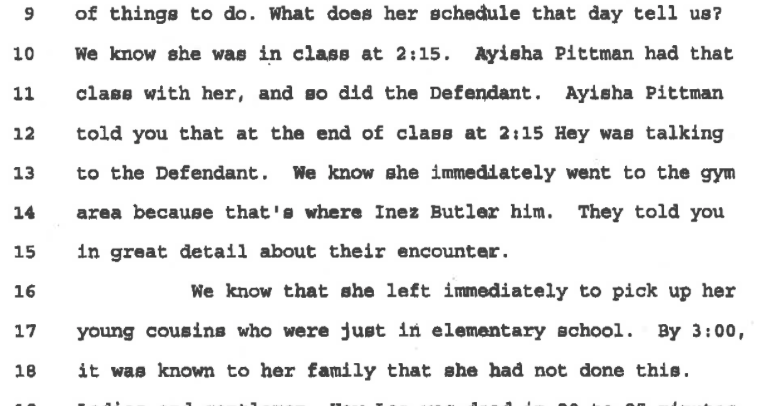
You can practically see the State writing Debbie out of the timeline. Aisha and Inez “told you in great detail” about interacting with Hae; conversely, Debbie is never asked about her encounter with Hae at 3:00. There’s probably good reason for this. In Debbie’s first police statement, she said that Hae told her during this encounter that she was going to see Don at the mall, which would have been disastrous to the State’s case. In Debbie’s second police statement, she recalled “Takera” asking Hae for a ride during this encounter and Hae turning her down because she had to pick up her cousin and had no time.
Of course she had no time. As you can see from the end of the previous excerpt, the State claimed that Hae’s family knew by 3:00 that she hadn’t picked up her cousin. The jurors ostensibly wrote Debbie out of the timeline just like the State because her non-specific testimony made no sense given the testimony by other witnesses and the cousin pickup time asserted by the State. By way of contrast, Asia has a very specific recollection of seeing Adnan on January 13th, and the only thing rebutting her testimony would have been the tenuous testimony of Jay.
The court also noted that Adnan’s father testified contrary to the State’s timeline, again to try to prove that additional contradictory testimony by Asia wouldn’t have led to a different result. The problem is that the Court of Appeals of Maryland addressed the same issue in In re Parris W. In Parris W., the defendant was convicted despite his father testifying as an alibi witness. Maryland’s highest court reversed, finding that the additional testimony by a neutral alibi witness (much like Asia) could have created a different result.
The fourth problem for the State is that it fails to distinguish the findings of prejudice in any of the alibi/ineffective assistance cases cited by Adnan’s attorney. Let’s look a quick look at the two most important cases. In In re Parris W., the victim identified the defendant as his assailant. In Griffin, the defendant was identified as the robber by two security guards, with one of them also identifying his alibi witness as a co-conspirator. In both cases, uncontacted alibi witnesses who contradicted the State’s timeline were sufficient to prove prejudice. If anything, the State’s evidence in both of those cases was stronger than the evidence against Adnan.
__________________________
*I’ve already expressed my thoughts about Adnan’s claim of ineffective assistance of counsel based upon his trial attorney’s failure to seek a plea deal, and I don’t really have additional analysis to add.
**Some people have speculated that the “Summer” in the alibi notice was the Summer interviewed on Serial (who likely had the wrong day). She wasn’t. The “Summer” in the alibi notice attended Adnan’s mosque.
-CM