
An Addendum to the Addendum: Hae’s Second Diary & A Possible Due Process Clause Violation
In yesterday’s Addendum episode of the Undisclosed Podcast, Susan discussed a very “interesting” statement made by prosecutor Kathleen Murphy in her closing argument at the trial of Adnan Syed for murdering Hae Min Lee. Here’s the statement (pages 75-76):
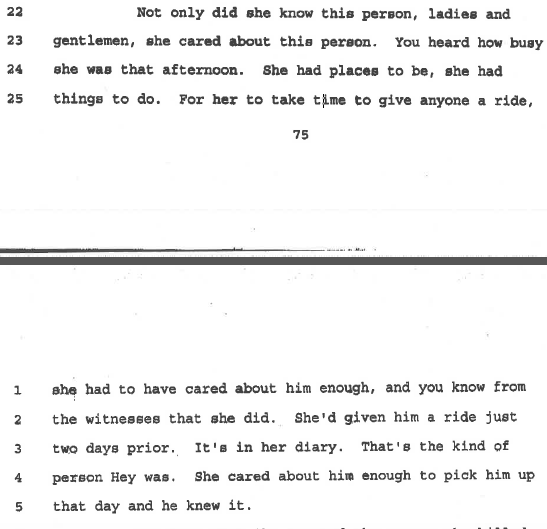
This statement is interesting because we have Hae’s diary…her “print” diary. In it, the last ride that Hae mentions giving to Adnan occurred on December 31, 1998. That’s two weeks before January 13th and the day before Hae started dating Don. So, what was the basis for Murphy making this claim?
We know from testimony by Hae’s brother Young that Hae had a second “diary” in the form of entries about private matters that she recorded on floppy disks (page 73):
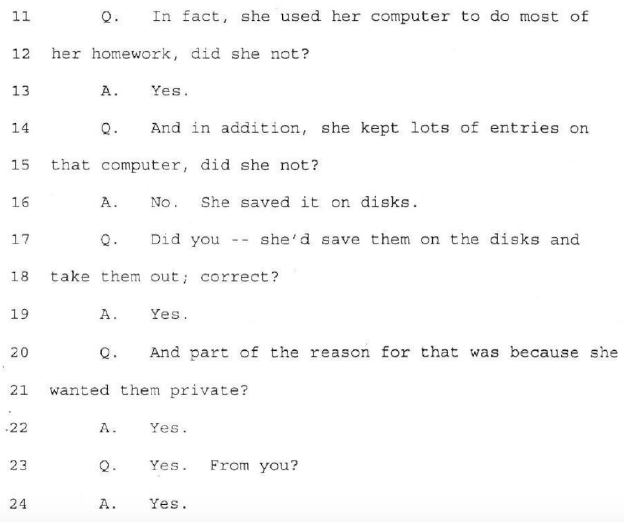
We also know that a floppy disk was one of several items recovered from Hae’s car:

This disk, however, was lost and never turned over to the defense or introduced into evidence. Before, it was lost, however, was it reviewed by Murphy? Murphy’s statement during closing raises three possibilities: (1) Murphy was mistaken about the diary entry; (2) Murphy was lying about the diary entry; or (3) Murphy had read a diary entry on Hae’s floppy disk about a ride on January 11th before that disk was lost.
The best case scenario for the State is that Murphy was merely mistaken, which would have no legal consequences. The question, of course, is whether Murphy could have made such an egregious mistake. Could Murphy really have thought that a diary entry from two weeks before January 13th was actually from two days before January 13th? This would be a pretty significant mistake given that the ride actually took place in a different year (1998, not 1999) and before Hae started dating her new boyfriend.
A worse scenario for the State is that Murphy was simply lying, but I don’t think Murphy was lying. After all, Hae’s print diary was admitted into evidence, so it would have been easy enough for jurors to realize that it didn’t indicate Hae gave Adnan a ride on January 11th. It’s also pretty hard for me to believe that Murphy would intentionally lie about something that didn’t have any basis in fact, which could lead to a mistrial and/or sanctions.
The worst, and probably most interesting, scenario for the State is that Murphy read the contents of the floppy disk before it was lost. Why?
There’s a classic Supreme Court case regarding the State’s loss or destruction of evidence: Arizona v. Youngblood. Youngblood was a child molestation case in which the State failed to preserve semen samples for testing. According to the Supreme Court, however, the Due Process Clause is only violated if there was a bad faith loss, destruction, or failure to preserve potentially exculpatory evidence. This meant that the defendant was not entitled to relief because the semen samples (1) were not lost in bad faith; and (2) were merely potentially exculpatory, i.e., testing of the semen samples could have determined that the defendant was an unlikely source of the semen, or the testing could have determined that the defendant was a likely source of the semen.
In its subsequent opinion in California v. Trombetta, however, the Court noted that even the good faith loss, destruction, or failure to preserve evidence violates the Due Process Clause if (1) the evidence was apparently exculpatory; and (2) “the defendant would be unable to obtain comparable evidence by other reasonably available means.” What does this mean? Let’s take a look at a real world hypothetical I give to my Criminal Adjudication students:
Kyle Huggett is charged with second-degree intentional homicide based upon the shooting death of John Peach, the ex-boyfriend of Huggett’s pregnant girlfriend. This killing was preceded by Peach sending several voicemail and text messages to his ex-girlfriend. Peach was screaming on the voicemail messages and all of the messages contained threats to harm Huggett. The sheriff’s office takes possession of the ex-girlfriend’s phone as evidence, and a sheriff listens to the messages. When defense counsel seeks to obtain the messages during discovery, the government learns that the messages have been deleted by the cell phone service provider based on the passage of time. Huggett moves for dismissal of the case with prejudice, claiming that he needed the messages to prove that he acted in self-defense. How should the court rule? See State v. Huggett, 783 N.W.2d 675 (Wis.App. 2010).
The answer is that the court dismissed the case with prejudice (and the appellate court affirmed on appeal). The reason is that the evidence was apparently exculpatory. In other words, this wasn’t a case in which the State lacked knowledge of the content of the voicemail messages, which would have made them merely potentially exculpatory. Instead, a sheriff listened to the messages and knew their content, making them apparently exculpatory because their exculpatory value was clear or apparent. Moreover, the court found that Huggett could not obtain comparable evidence because the messages had been deleted. Therefore, the case had to be dismissed even though the messages were “lost” in good faith.
Let’s now turn to Adnan’s case. Obviously, the floppy disk from Hae’s car was lost, and there was no evidence of a January 11th ride in Hae’s print diary, so Adnan could not get comparable evidence. This leaves the question of whether the floppy disk diary was apparently exculpatory. If Murphy did in fact get the information about the January 11th ride from the floppy disk, I would say that we already know from her statement during closing argument that the floppy disk was apparently exculpatory. To wit, I can immediately think of three ways in which Adnan’s trial attorney could have used evidence about a January 11th ride:
1. Physical evidence from Adnan, including his fingerprints, was found in Hae’s car. If Hae gave Adnan a ride on January 11th, that provides a much better explanation for this physical evidence than a last (recorded) ride on December 31st.
2. We know that several witnesses in the case could have had the wrong day, with some witnesses (such as Debbie) even acknowledging that they could have had the wrong day. The defense could have used a January 11th ride to create doubt about whether witnesses testifying about Adnan’s ride request had the wrong day.
3. The State’s whole theory of the case was that Adnan lied to Hae to get a ride. If the last record of Hae giving Adnan a ride was on December 31st, before she started dating Don, this makes a good deal of sense. But, if Hae willingly gave a ride to Adnan two days before January 13th, why would Adnan need to lie to get a ride a mere two days later?
Of course, there could have been other helpful things on the floppy disk. Assume, for instance, that the January 11th entry mentioned that the ride to Adnan was a “ride home” so that Adnan could change for track practice. This would provide an “innocent” explanation for the January 13th ride request that was otherwise lacking.
At this point, I’m delving into speculation, but…that’s the point. If Murphy’s closing statement was based upon Hae’s floppy disk diary, we know that the disk had apparently exculpatory information, and we can only speculate about what else it contained. That’s why even the good faith loss or destruction of such evidence is a Due Process Clause violation that should lead to dismissal or at least an adverse inference instruction (telling jurors that they can assume any information on the lost floppy disk would have been helpful to Adnan).
Simply put, this is a serious issue and one that I think Murphy should have to answer. If Murphy’s response is that she was simply mistaken when she made her statement during closing…fair enough. You have to take her at her word and assume that this was an honest mistake. But if Murphy does recall reading a diary entry about Hae giving Adnan a ride on January 11th, and such an entry was never disclosed to the defense, there’s a pretty strong argument that there was a Due Process Clause violation.
[Update: A few people have questioned whether Murphy in fact said that the January 11th ride was in Hae’s diary. Let’s assume that those people are correct and that Murphy was relying upon some source of information other than Hae’s diary/diaries to make the claim about the January 11th ride. That’s actually worse for the State. If Murphy was referencing Hae’s diary, then you could at least imagine her relying on the print diary and getting the date wrong. Conversely, if Murphy wasn’t relying on Hae’s diary/diaries, there has to be some other source of information for the January 11th ride such as a letter or e-mail written by Hae that was never disclosed to the defense. In that case, there would definitely be a Due Process Clause violation].
[Update #2: As a commenter noted below, Debbie actually read the diary entry about Hae giving Adnan a ride on December 31, 1998. It was a diary entry from January 2, 1999 referencing a ride that Hae gave to Adnan on New Year’s Eve. As with so many things in this case, we now have several different explanations for Murphy’s statement during closing that Hae had given Adnan “a ride just two days prior.”
1. Murphy meant that Hae had given Adnan “a ride just two days prior” to her January 2nd diary entry.
2. Murphy meant to say that Hae had given Adnan “a ride just two weeks prior” to January 13, 1999 and simply said days instead of weeks.
3. Murphy was lying.
4. Murphy was confused and thought that the ride of December 31st was a ride given two days prior to January 13, 1999.
5. Murphy’s statement was accurate and was based upon a second diary or some other source of information that was not disclosed to the defense.
Option 1 doesn’t make much sense to me. Why would it be important that Hae gave Adnan a ride just two days before her January 2nd diary entry, even if that were the last entry when she mentioned Adnan? In fact, wouldn’t that be the point…that Hae’s last ride to Adnan was before she had moved on and started dating Don?
Option 2 also doesn’t make much sense to me. I don’t see Murphy constructing a sentence where she says that Hae gave Adnan a ride just two weeks prior. That seems pretty meaningless to me. What does a ride that (1) took place over winter break; (2) in 1998; (3) before Hae was dating Don tell us about the events of January 13th?
I already stated in my initial post why I don’t think Option 3 makes any sense.
That leaves us with Option 4 and Option 5. Option 4 is an honest but serious mistake. In this option, Murphy somehow gets it in her head that the ride on December 31st was a mere two days before January 13th and makes a very misleading statement to the jury. As I said in my initial post, I would accept an admission that this was a mistake and move on. Such a mistake wouldn’t be actionable at all.
Option 5 means that there was very likely a Due Process Clause violation for the reasons discussed in this post.].
-CM