
The State’s Brief, Take 3: Disbelief as an Improper Basis for Failing to Contact an Alibi Witness
In Friday’s post, I cited to a case that directly contradicted one of the findings of the Baltimore City Circuit Court in denying the petition for postconviction relief brought by Adnan Syed. Adnan, of course, has claimed, that his trial counsel was ineffective based upon failure to contact potential alibi witness Asia McClain, who has claimed that she saw Adnan at the Woodlawn Public Library until 2:40 P.M. on January 13, 1999, the same day on which the prosecution claimed that Hae Min Lee was killed at Best Buy by 2:36 P.M.
In rejecting Adnan’s petition, the Circuit Court noted that Adnan’s attorney might have chosen not to contact Asia because Asia’s story about seeing Adnan at the library until 2:40 P.M. on January 13, 1999 contradicted Adnan’s “own stated alibi that he remained on the school campus from 2:15 p.m. to 3:30 p.m.” (page 11). In response, I discussed Lawrence v. Armontrout, 900 F.2d 127 (8th Cir. 1990), a case cited with approval by both the Fourth Circuit and the Court of Special Appeals of Maryland (the same court handling Adnan’s appeal). You can read that post to see why this finding by the Circuit Court fails to hold water.
That still, however, leaves the other two reasons why the Circuit Court denied Adnan’s petition: (1) Adnan failed to prove that Asia was a concrete alibi witness because her letters failed to state the time when she saw Adnan on January 13, 1999; and (2) “trial counsel could have reasonably concluded that [Asia] was offering to lie in order to help petitioner avoid conviction.” (pages 11-12).
I now feel like I’ve found an analogous case that refutes both of these conclusions: Montgomery v. Petersen, 846 F.2d 407 (7th Cir. 1988).
Petersen was cited with approval in In re Parris W., 770 A.2d 202 (Md. 2001), and Griffin v. Warden, Maryland Correctional Adjustment Center, 970 F.2d 1355 (4th Cir. 1992), the key ineffective assistance/alibi witness cases decided by the Court of Appeals of Maryland and the Fourth Circuit. It was also cited extensively by Adnan’s attorney in his Brief of Appellant. Before reading the case closely, however, I didn’t quite realize the importance of the case.
In Petersen, Carl Montgomery was charged with burglaries committed in Moultrie County and Macon County, Illinois on September 9, 1983. Carl was convicted of the Moultrie Country burglary in large part based upon the testimony of his half brother and alleged accomplice, Wayne (Butch) Montgomery. Butch pleaded guilty to the Moultrie County burglary and testified that “he did not expect to gain any favoritism based on his testimony in the present case.”
Butch testified that he met Carl in Beardstown, Illinois between 8:30 and 9:00 A.M. on September 9th and discussed a possible burglary in Arcola, Illinois in front of his wife, Mary Lou. Mary Lou also testified at trial and confirmed that she heard Butch and Carl discuss this possible burglary. According to Butch, however, Carl and he scrapped their initial plan and instead burglarized homes in Moultrie County and Macon County.
Butch testified that, after spending the entire day together, Carl and he returned to Carl’s home in Springfield between 8:30 and 9:00 P.M. that same day, whereupon Carl called John Mardis and Orville Bartells, whom Carl thought might be able to “move” the items they had stolen. These calls were proven at trial through Carl’s phone records, which showed calls to Mardis’s home at 9:33 and 9:50 P.M. as well as a call to Bartells’s residence at 9:43 P.M. Butch testified that Carl and he did in fact leave to go to Orville’s house at 10:00 P.M.
Butch’s testimony about arriving at Carl’s home between 8:30 and 9:00 P.M. was corroborated by the testimony of Carl’s brother and the girlfriend of Carl’s brother, both of whom recalled Carl and Butch arriving at Carl’s home between 8:30 and 9:00 P.M. on September 9th. On the other hand, Butch’s testimony about September 9th was contradicted by 12 alibi witnesses whom defense counsel presented at trial. Each of these witnesses was a close friend or relative to Carl, and each testified to seeing Carl in Springfield at some point during the day on September 9th. In particular, Carl’s wife testified that Carl’s brother and the girlfriend of Carl’s brother were thinking of September 10th instead of September 9th.
After Carl was convicted of the Moultrie County burglary, his wife and mother-in-law followed up on a receipt that Carl’s trial counsel had failed to investigate. The receipt was for the purchase of a bicycle at Sears on September 9, 1983; as far as I can tell, the receipt didn’t list a time of purchase. The receipt also didn’t list the sales clerk’s name, but it did list his employee code. Here’s the testimony of Carl’s attorney about the receipt:
“I was given just a receipt. I wasn’t given a name so I didn’t know who to interview until I found out who the witness was. But at that point, I simply didn’t believe the defendant so I didn’t think it happened.”
Conversely, Carl’s wife and mother-in-law did track down this sales clerk, who told them he had a specific recollection of selling Carl the bicycle at 1:15 or 1:30 P.M. on September 9, 1983 because it was the only bicycle he sold that day. The sales clerk gave testimony to this effect at Carl’s trial for the Macon County burglary, and Carl was found “not guilty” of that crime.
Carl thereafter appealed his conviction for the Moultrie County burglary, claiming that he received the ineffective assistance of counsel based upon his trial attorney’s failure to investigate and interview the sales clerk. After being unsuccessful at the state court level, Carl was given relief by the United States District Court for the Central District of Illinois. This decision was later affirmed by the Seventh Circuit, in the opinion cited by the Court of Appeals of Maryland and the Fourth Circuit.
The first question that the Seventh Circuit had to answer was whether trial counsel’s decision not to investigate and interview the sales clerk was unreasonable. The Seventh Circuit answered this question in the affirmative, finding that
it is important to keep in mind that trial counsel’s failure to investigate the Sears receipt was not, by counsel’s own admission, a strategic decision. Rather, he testified that his failure was due to “inadvertence” as well as the fact that he “simply didn’t believe” the petitioner. In Strickland, the Supreme Court noted that information supplied by the defendant is a prime source of the factual bedrock upon which counsel must rely in making strategic choices.
The Seventh Circuit then noted that this principle from Strickland has been applied by courts from across the country, including the Seventh Circuit in its prior opinion in United States ex rel. Cosey v. Wolff. It then cited the following language from Wolff, adding the emphases included in the quotation:
Cosey’s entire defense at trial rested on discrediting the state’s main witness—the victim. The five proffered witnesses would not only have corroborated Cosey’s story and further impeached the victim’s version, but, as the state conceded in oral argument, if the witnesses were believed, their testimony alone would have entirely exculpated Cosey. Without interviewing and investigating such promising witnesses, Cosey’s attorney had no reason to believe they would not be valuable in securing Cosey’s release. Although three of the witnesses had an apparent reason to be biased in Cosey’s favor, that alone is insufficient cause to automatically reject them. Moreover, two of the proffered witnesses had no apparent reason for bias. There was no strategy involved here, only negligence.
Given this language, the Seventh Circuit was easily able to conclude that Carl’s trial counsel acted unreasonably in failing to interview and investigate the Sears sales clerk. One key point for the court was that the sales clerk “was the only disinterested witness in the case. All twelve of the other defense witnesses were either close friends or relatives of the petitioner.”
This factor strongly supported a finding a unreasonableness despite two factors that worked against Carl: (1) defense counsel did produce 12 alibi witnesses; and (2) defense counsel did not have the name or address of the sales clerk. With regard to this latter point, the Seventh Circuit concluded as follows:
Nor can we say that defense counsel’s conclusory statement that he did not believe his client was an adequate basis for ignoring such an important lead. Indeed, if counsel had taken the few steps necessary to identify and interview the Sears clerk, he may well have formed a more favorable view of his client’s veracity.
The second question that the Seventh Circuit had to answer was whether trial counsel’s decision not to investigate and interview the sales clerk was prejudicial, i.e., whether interviewing and investigating the clerk would have created the reasonable probability of a different outcome at trial. Again, the court was easily able to conclude that Carl established prejudice. Initially, the court noted that the sales clerk “directly contradicted the state’s chief witness, who testified that he and the petitioner were together outside of Springfield from 9:00 a.m. until 9:00 p.m. that day.”
Next, the sales clerk “provided the petitioner with an unbiased alibi defense. As such, it did not merely raise doubts about the petitioner’s guilt; if believed by the jury, it would have directly exonerated him of the crime.” Additionally,
where the evidence of the petitioner’s guilt is overwhelming. Rather, the state’s case depended on the relative credibility of Wayne Montgomery and the petitioner. Because the verdict against the petitioner rested primarily on the testimony of the confessed accomplice, it is “‘more likely to have been affected by errors than one with overwhelming record support.'”
Finally, the Seventh Circuit found Carl’s acquittal for the Macon County burglary to be persuasive evidence of the importance of the testimony by the Sears sales clerk.
Petersen is so interesting because it resembles Adnan’s case in so many ways. Of course, some of the facts in Adnan’s case are less favorable than the facts in Petersen, but other facts in his case seem more favorable. Let’s do a comparison:
•Both convictions were largely based upon the testimony of alleged accomplices and corroborating call records.* The accomplice in Petersen pleaded guilty to the primary offense, seemingly got no benefit for testifying against the defendant, and, as far as I can tell, never changed his story or admitted to lying. The accomplice in Adnan’s case pleaded guilty to accessory after the fact, got no prison time, and admitted to lying and changing his story multiple times. The accomplices in both cases described evening phone calls (regarding the “moving” of stolen goods and the burying of the body) that were incriminatory. Your belief about how much stronger the call evidence was in Adnan’s case likely depends on how much stock you put in cell tower pings.
•Both alleged accomplices were corroborated to a certain extent. Jenn and “Cathy” both lacked direct knowledge of the murder/burial of Hae Min Lee, and their statements alternately meshed and clashed with Jay’s testimony. The testimony by Carl’s brother and the girlfriend of his brother meshed with Butch’s story, and Butch’s wife also claimed that she directly heard Butch and Carl planning a burglary (albeit a different burglary). It’s also possible that witnesses in both cases had the wrong day.
•Like Carl’s attorney, Adnan’s attorney did (if we believe the alibi notice) investigate a number of alibi witnesses, all of whom were close friends and family. Like Carl’s attorney, Adnan’s attorney seemingly failed to investigate and interview the one unbiased alibi witness available. Unlike Carl’s attorney, Adnan’s attorney had the name and contact information for this alibi witness.
•Both Carl and Adnan only interacted with their alibi witnesses for relatively short periods of time (10-20 minutes with Asia; the length of time it took to purchase the bicycle with the clerk). Both alibi witnesses were also asked to recall the timing of the interactions months later when they were tracked down by friends/family.
•Carl’s attorney presented a stronger defense with more alibi witnesses. This is kind of a double edged sword. On the one hand, you might conclude that the case against Carl was weaker; on the other, you might conclude that (as the State argued) the number of alibi witnesses presented by Carl’s attorney meant that an additional alibi witness was merely cumulative and less important. The exoneration of Carl for the Macon County burglary was also strong persuasive evidence of prejudice.**
•Besides inadvertence, the reason given by Carl’s attorney for failing to investigate and interview the Sears sales clerk was disbelief of Carl. Disbelief was also the apparent basis for the two hypothetical strategic reasons that Adnan’s trial attorney might not have contacted Asia McClain.
This last point takes me to the point of this post. Here was the Circuit’s Court’s entire discussion of the aforementioned two possible “strategic” reasons Adnan’s trial attorney might have failed to contact Asia McClain:
[T]he Court finds
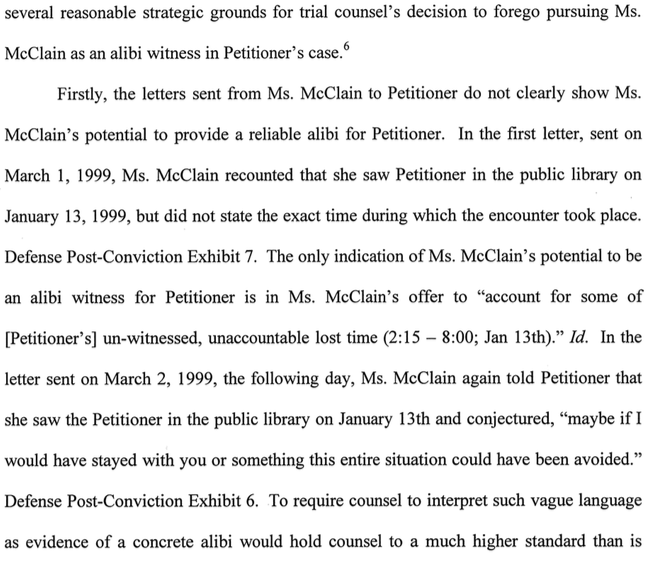

Let’s start with the court’s argument that Asia’s letters “did not state the exact time during which the counter took place.” My response: So what? As noted by the Seventh Circuit in Petersen and the Supreme Court in Strickland, “information supplied by the defendant is a prime source of the factual bedrock upon which counsel must rely in making strategic choices.”
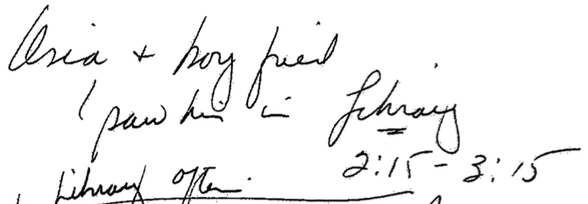
The Asia letters don’t state times, but we know from notes taken by Adnan’s attorney
and her clerk

that Adnan assigned times for the encounter in the library. Therefore, according to defense counsel’s prime source of information — Adnan himself — the encounter took place at a time or at some point during a time frame that was exceedingly relevant to the case.
Frankly, I find it kind of bizarre that the court focused on the fact that Asia’s letters didn’t state an exact time for the encounter. In the vast majority of cases, the defendant will simply tell an attorney about a prospective alibi witness, and the attorney will have no independent corroboration by the alibi witness. Conversely, in Adnan’s case, Adnan’s attorney had Adnan’s assigned times for seeing Asia in the library and Asia’s letters about seeing Adnan in the library on January 13th…as well as Asia’s phone number. All that defense counsel needed to do was have someone on her team call Asia to see whether Asia saw Adnan at some point between 2:15 and 3:15 P.M.
This can be contrasted with Petersen, where defense counsel merely had a receipt that didn’t list the sales clerk’s name or contact information. Additionally, the receipt apparently didn’t list a time of purchase or purchaser information. Simply put, this receipt was much less “concrete” than Asia. Indeed, I would imagine that the information that Adnan’s attorney had about Asia was a lot more concrete than the initial information that most attorneys have about prospective alibi witnesses.
This, of course, leads into the second argument made by the Circuit Court, which is that Adnan’s attorney could have concluded that Asia was offering to lie…with Adnan feeding her the lie. In other words, Asia offered to account for some of Adnan’s unaccountable time between 2:15 and 8:00 and wondered about whether the “situation” could have been avoided if she stayed with him longer at the library. In turn, the notes by Adnan’s attorney and her clerk suggest…well, I don’t know what they suggest; they’re notes. Does the attorney note suggest that Adnan told his attorney that he saw Asia (1) from 2:15-3:15; (2) for some period of time between 2:15 and 3:15; or (3) at some point between the end of school and the start of track practice? And does the clerk’s note suggest that Adnan told the clerk that he saw Asia (1) at 3:00; (2) up until 3:00; (3) at around 3:00; or (4) as Adnan testified, prior to 3:00, which is when Adnan left the library, after Asia had already left with her boyfriend?
I don’t know, but I read the Circuit Court’s conclusion as follows: Adnan’s attorney could have concluded that (1) Asia was offering Adnan an alibi blank check between 2:15 and 8:00; and (2) Adnan sought to cash that check by claiming that Asia would have seen him up to 3:00 or 3:15. As such, she could have made the “strategic” reason not to contact Asia. Now, I personally disagree with this reading of Asia’s letters, but that’s not the point.
The point is that the Seventh Circuit in Petersen said that disbelief of a client is not a reason to refrain from contacting an alibi witness. Indeed, the Seventh Circuit found that failing to contact a prospective alibi witness based upon disbelief is not strategy at all. Take another look at the court’s italicized citation to Wolff:
Without interviewing and investigating such promising witnesses, Cosey’s attorney had no reason to believe they would not be valuable in securing Cosey’s release.
That’s pretty much the exact same language used by the Fourth Circuit in Griffin, the opinion addressing a case handled by the same courts handling Adnan’s trial/appeal. The same logic applies here. Just as in Petersen, contacting Asia could have led Adnan’s attorney to disbelieve Asia’s alibi, but it also could have caused her to trust it more.
Again, I don’t know exactly what Adnan told his attorney about when he saw Asia, but I do know what Asia has said: she saw him for 10-20 minutes, until about 2:40 P.M. (first affidavitsecond affidavit). I think the shortish duration of the encounter described by Asia bolsters her credibility, but that’s not really the point. The point is that Adnan’s defense attorney couldn’t have written Asia off without first investigating and interviewing her to determine whether she was being honest and accurate. Without such investigating and interviewing, Adnan’s attorney acted unreasonably. Because the State’s case was built on accomplice testimony that was weaker than the accomplice testimony in Petersen, and because Asia’s alibi contradicted the State’s timeline, this error was prejudicial.
__________________________
*According to the Baltimore City Circuit Court, “The State’s case rested largely on the testimony of [Jay] and the corroborating cell phone records.”
**Of course, an argument could be made that the favorable “polling” of jurors after Adnan’s first trial (noted by the State in its Brief (page 3)) shows the tenuousness of the prosecution’s case against Adnan. Of course, that was merely informal “polling,” and it was done before the State had presented its full case; that said, it was also done before the defense had presented any of its case.
-CM