
Episode 1 of Undisclosed & Further Thoughts About Debbie’s Testimony at Trials 1 & 2
Yesterday was the premiere of the first episode of “Undisclosed: The State v. Adnan Syed.” We had some recording difficulties while doing the group recording of Rabia, Susan, and myself, so we each ended up having to record individual parts that were stitched together. As a result, the final recording has some varying volumes, not enough free flowing conversation, and what I regard as some stilted delivery on my part (it’s a lot tougher to talk to a computer screen than someone else). That said, I’m very proud of the finished product and the hard work that was put into creating it. If you enjoyed the first episode, be sure to check out the second episode on April 27th. And, if you’re not sold after the first episode, I feel like I can guarantee that the quality of the second episode will be much higher for a variety of reasons.
I’ve already been getting some good feedback about my comments about Debbie’s testimony at the first and second trials and the difference between guilt and innocence. Given that feedback, I thought I’d expand upon my comments from the podcast in a blog post.
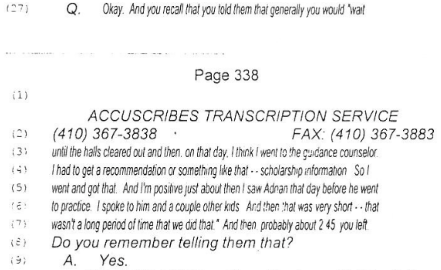
Let’s start with the basics. At Adnan’s first trial, on December 13, 1999, the following Q&A occurred between defense counsel and Debbie (pages 337-338):
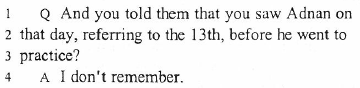
Then, a little over two months later, on February 17, 2000, here are the relevant Q&As between defense counsel and Debbie at Adnan’s second trial (page 109):

So, how could I conclude that Adnan would have been found “not guilty” if Debbie simply repeated her testimony from the first trial at the second trial?
As I noted in the podcast, the prosecution pretty clearly established that Adnan asked Hae for a ride on January 13, 1999, a fact I’ve never disputed. Then, they had Hae’s best friend Aisha testify that she saw Hae and Adnan talking at the end of school (page 251).*
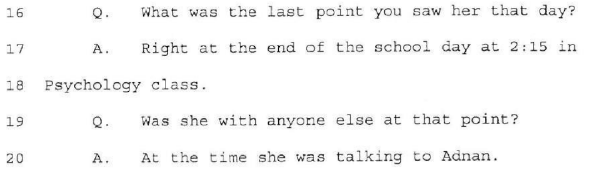
Finally, they had Inez Butler testify that she saw Hae leaving school in a hurry between 2:15 and 2:20 (page 20):

During closing argument, the prosecution used the testimony of these two witnesses to claim that Hae left school with Adnan immediately after talking to Inez, whereupon he killed her in the Best Buy parking lot by 2:36, when he called Jay:

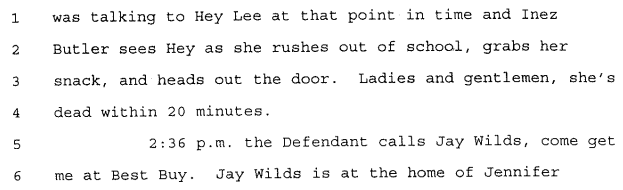
In other words, the prosecution didn’t merely assert that Hae could have been killed by 2:36; instead, it very deliberately used three pieces of evidence — Aisha’s testimony, Inez Butler’s testimony, and the 2:36 call on Adnan’s call log — to prove that Hae left school soon after 2:20 P.M. and must have been killed by 2:36 P.M.
This is why Debbie’s statement that she was positive she saw Adnan at about 2:45 at the guidance counselor’s office was potentially so devastating to the prosecution’s case. She initially made that claim in a police statement on March 26, 1999, she remembered making the statement while testifying on December 13, 1999, and then…she forgot about the statement while testifying on February 17, 2000.
As I noted on the podcast, if Debbie had simply remembered her statement, the defense could have turned a prosecution witness into an alibi witness…a witness who would have consistently stated on three occasions that she saw Adnan at about 2:45 at the guidance counselor’s office, about 20-25 minutes after Hae supposedly left school and about 9 minutes after she was supposedly dead and Adnan was making a call from Best Buy. The way I see it, that would have been devastating to the prosecution’s case.**
Moreover, even with Debbie forgetting her statement at the second trial, defense counsel still had some options. First, defense counsel seriously erred by not mentioning the time that Debbie said she saw Adnan at the second trial. As you can see from the above Q&As from the second trial, defense counsel never asked Debbie about seeing Adnan at “about 2:45,” which was the most important part of her statement.
Second, as I’ve previously noted, at the time of Adnan’s second trial, Maryland Rule of Evidence 5-802.1(a) allowed for the admission of prior inconsistent statements in the form of both former testimony and recorded statements. Such statements was non-hearsay and thus admissible to prove the truth of the matter asserted: that Debbie saw Adnan at about 2:45 at the guidance counselor’s office. Therefore, when Debbie testified at the second trial that she did not remember making the statement about seeing Adnan at the guidance counselor’s office, defense counsel immediately should have admitted both her police statement and her testimony from the first trial. She didn’t. Would doing so have been enough to change the outcome at the second trial? I don’t know, but it couldn’t have hurt.
[Update: I’ve been getting some questions about whether the prosecution simply would have shifted away from the 2:36 timeline if Debbie had remembered saying that she saw Adnan at the guidance counselor’s office at about 2:45. I guess it’s theoretically possible, but take a look at the prosecution’s opening statement from the second trial on January 27, 2000 (pages 106-107):
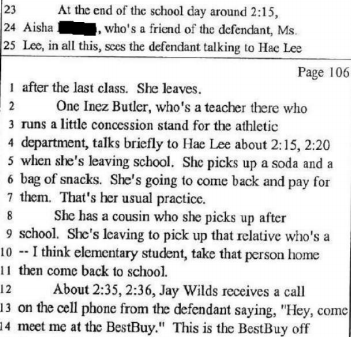
So, if the prosecution wanted to shift away from the 2:36 timeline in closing, it would have needed to contradict its timeline from opening and explain why Inez (its own witness) was wrong when she testified that she saw Hae leaving school in a hurry between 2:15-2:20. It also would have needed to explain why Becky was wrong when she similarly claimed that she saw Hae heading to her car at about 2:20 because she had somewhere she needed to be.
Or is the claim that the prosecution’s strategy from the start of trial would have been different if it knew Debbie was going to testify that she saw Adnan at 2:45 on January 13th? In that case…what? The prosecution would have claimed that the Best Buy call was the 3:15 call? Inez would have been written out of the timeline? The prosecution would have relied on Debbie’s first police statement, in which Debbie said she said that Hae told her at about 3:00 P.M. “that she was going to see Donald at the mall”? Or would the prosecution have relied on Debbie’s second police statement, in which she remembered (1) seeing Hae between 2:45 and 3:15; (2) “Takera” and no one else asking Hae for a ride; and (3) Hae turning “Takera” down for a ride because she didn’t have time/was picking up her cousin?
I think you see my point. It’s possible that the prosecution could have shifted away from the 2:36 timeline, but doing so likely would have weakened, not strengthened, its case.]
_______________________
*As noted in the podcast and on this blog, if you believe Krista, and I do, Aisha overheard Hae telling Adnan that something came up and she could no longer give him a ride.
**In this post, I’m only talking about Adnan’s legal innocence/guilt. As I’ve noted, there are real questions about whether Debbie actually saw Adnan (a) on January 13, 1999; and (b) at 2:45 P.M. That said, as I noted on the podcast, in her police statement, Debbie was initially quite sure that she saw Adnan on January 13th before saying that it could have been the day before or the day after. But Debbie also remembers talking to Adnan about going to track practice, and there was no track practice on January 12th (track meet) or January 14th (snow day). The prosecution did nothing to discredit Debbie’s testimony from the first trial about seeing Adnan, and it’s tough to see how it could have discredited similar testimony from the second trial. Luckily for the prosecution, it didn’t have to engage in the rare action of impeaching its own witness due to Debbie’s sudden forgetfulness.
-CM