
The Autopsy Posts: An Introductory Post Concerning Blunt Force Injuries
This is my fourth post about autopsies following my first, second, and third posts. Once again I will be looking at the autopsy report for Hae Min Lee. In my first and second posts, I noted how certain findings in the autopsy were consistent with the Assistant Medical Examiner’s conclusion that the cause of Lee’s death was strangulation. In this post, however, I want to focus on other injuries suffered by Lee. According to the autopsy report,
“Blunt force injuries to the right back and right side of the head were also present.”
Specifically,
“There were focal and poorly delineated right occipital subgaleal and right temporalis muscle hemorrhage.”
The Assistant Medical Examiner testified that these injuries were caused while Lee was still alive. According to the key witness for the prosecution, Adnan Syed strangled Lee while she was in the driver’s seat of her 1998 Nissan Sentra, with Lee kicking at Syed and trying to say something like “I’m sorry” while she was being strangled. That same witness made no mention of Adnan otherwise striking Lee or using a weapon.
Now, based upon information I have now received from an assistant medical examiner and a pathology resident who has completed extensive rotations in forensics, five conclusions can be drawn from the available evidence:
1. Given the severity of the blunt force injuries, it is likely that Lee was at least stunned, and the injuries are certainly consistent with Lee being knocked unconscious.
2. It is highly unlikely that Lee spoke or even came close to speech if she were being fatally strangled.
3. It’s possible that the blunt force injuries could have been caused by punches, but it is likelier that they were caused by a weapon or Lee’s head striking some fixed object.
4. If Lee were in the driver’s seat of the Sentra while being strangled, it is highly unlikely that she could have kicked at her assailant.
5. It is highly unlikely that the blunt force injuries to Lee’s head could have been caused by an attack on her while she was in the driver’s seat of her Sentra.
In today’s post, I will lay out the basics of the blunt force injuries uncovered in the autopsy. In successive posts, I will then explain conclusions 1-5.
Let’s start with the basics.
Blunt Force Injuries
As noted, according to the autopsy report, “[b]lunt force injuries to the right back and right side of the head were also present.” Blunt force injuries are “[i]njuries resulting from an impact with a dull, firm surface or object.” Blunt force injuries can be contrasted with penetrating injuries, which are caused “when an object pierces the skin, organ or body cavity.”
[A]lmost all transportation fatalities — including those involving motor vehicle collisions, pedestrians being struck by vehicles, airplane crashes, and boating incidents — result from blunt force trauma. Other deaths resulting from blunt force trauma involve jumping or falling from heights, blast injuries, and being struck by a firm object, such as a fist, crowbar, bat, or ball.
In an epidemiological study of 64 patients admitted to a hospital with blunt force injuries to the head, 55 (85.93%) were caused by motor vehicles accidents, 6 (9.83%) were caused by physical assaults, and 3 (4.68%) were caused by falls from height.
Lee had two blunt force injuries:
1. Right Occipital Subgaleal Hemorrhage
Lee had a “focal and poorly delineated right occipital subgaleal…hemorrhage.”
A subgaleal hemorrhage is bleeding between the skull and scalp, leading to swelling. It is possible to bleed profusely from ruptured blood vessels below the scalp, potentially causing shock in the patient due to blood loss. This condition is most commonly seen after traumatic birth, although it can also be caused by a fall or blow to the head.
A hemorrhage is subgaleal when it is below the the galea aponeurotica (epicranial aponeurosis, aponeurosis epicranialis), a tough layer of dense fibrous tissue which covers the upper part of the cranium. This image of a subgaleal hematoma (blood pooling) shows the location of a subgaleal hemorrhage (bleeding)
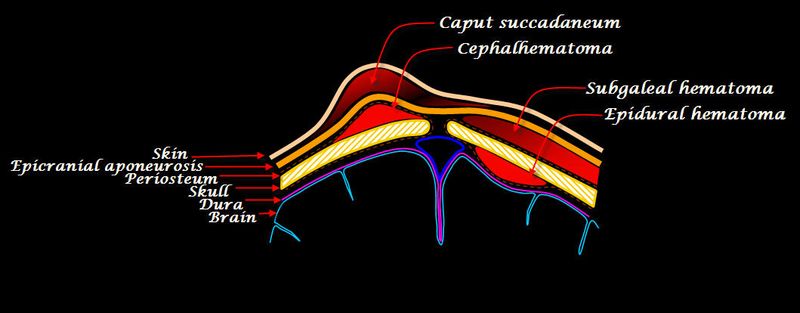
In other words, Lee’s subgaleal hemorrhage was right on the surface of the skull bone. Lee had a right occipital subgaleal hemorrhage. The occipital lobe is one of the four major lobes of the central cortex in the brain. It is located at the (posterior) back of the brain and is primarily responsible for vision.
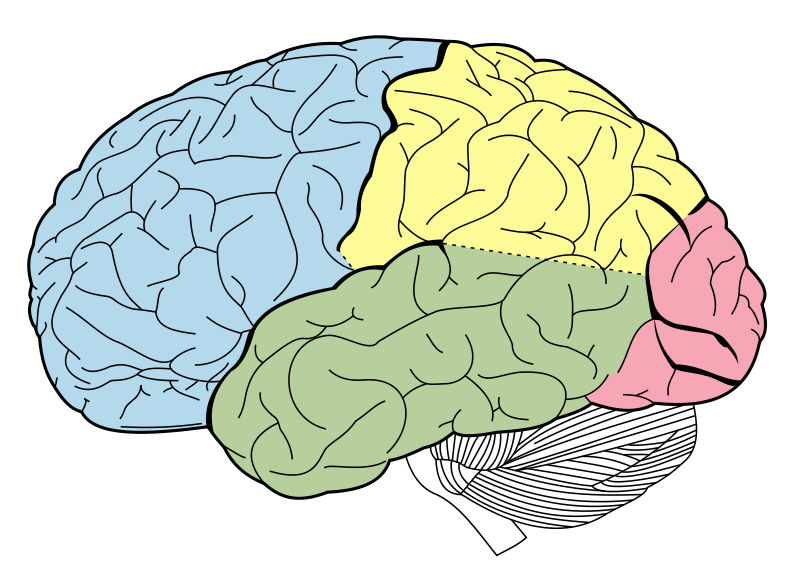
The occipital lobe is in pink.
Some refer to the occipital lobe as the occipital lobes, with the “left” occipital lobe and the “right” occipital lobe being separated by the cerebral fissure, the main line that divides the brain into the right cerebrum and the left cerebrum.
So, simply put, Lee suffered a blunt force injury — an injury resulting from impact with a dull, firm surface or object — that was significant enough to cause bleeding in the back right of the head below the scalp and the galea aponeurotica.
One of the more common reasons for injury to the occipital lobe is being in an automobile crash. Any time there is significant impact to the back of the head, there is a risk for damage. Rear end car crashes are particularly bad for occipital lobe injury because the head quickly moves forward and backward. Often when jerking backward, the back of the head slams forcefully against the seat. The higher the speed is upon impact, the greater the potential for damage.
Damage to the occipital lobe can also stem from any type of blunt force trauma. Although the human skull does a relatively good job of protecting the brain, excessive trauma to the back of the brain often results in occipital lobe injury. Things like falls, physical attacks and even sports injuries can create problems. Football players are especially at risk due to the prevalance of head-to-head contact.
2. Right Temporalis Muscle Hemorrhage
Lee also had a “focal and poorly delineated…right temporalis muscle hemorrhage.” The temporal muscle, also known as the temporalis muscle, is one of the muscles of mastication (chewing). It is one of several chewing muscles necessary for crushing objects (food) between the molars. The temporalis muscle is located underneath the temple; if you bite down on a pencil and press your finger against your temple, you will feel the muscle bulge in and out. You have temporalis muscles on both the left and right sides of your head.
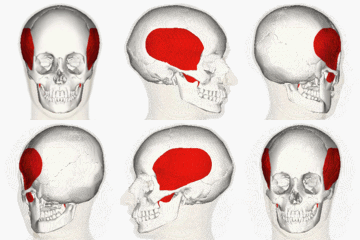
The temporalis muscle is covered by the temporal fascia, a strong, dense layer of fascia (fibrous tissue).
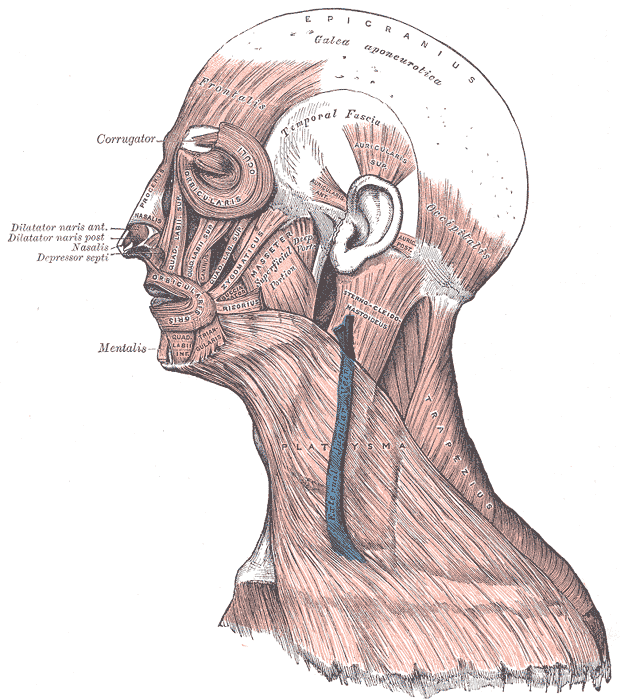
Because of its position under the temporal fascia, the temporalis muscle is well protected, and it takes a severe blow to the head to cause hemorrhaging to it. For instance, in Bessick v. Utilicon, 2001 WL 35938169 (Ohio Com.Pl. 2001), the victim was knocked down and rolled over by a dump truck backing up. According to the Deposition of Carl J. Schmidt, M.D., the
objective evidence for injury is that there was hemorrhage, albeit only a small amount, but there was hemorrhage in the membranes that cover her brain, and especially a portion of the brain known as the cerebellum which is a protected part of the brain. So that when you see hemorrhage in the linings that cover the brain and hemorrhage into temporal muscles, you’ve suffered a severe blow to the head, which means that you probably lost consciousness almost instantaneously.
Focal and Poorly Delineated
Both of these hemorrhages are described in the autopsy report as “focal and poorly delineated.” Focal injuries can be distinguished from diffuse injuries:
Focal and diffuse brain injury are ways to classify brain injury: focal injury occurs in a specific location, while diffuse injury occurs over a more widespread area….Focal injuries are commonly associated with an injury in which the head strikes or is struck by an object; diffuse injuries are more often found in acceleration/deceleration injuries, in which the head does not necessarily contact anything, but brain tissue is damaged because tissue types with varying densities accelerate at different rates….
A focal traumatic injury results from direct mechanical forces (such as occur when the head strikes a windshield in a vehicle accident) and is usually associated with brain tissue damage visible to the naked eye.
A Focal Brain Injury
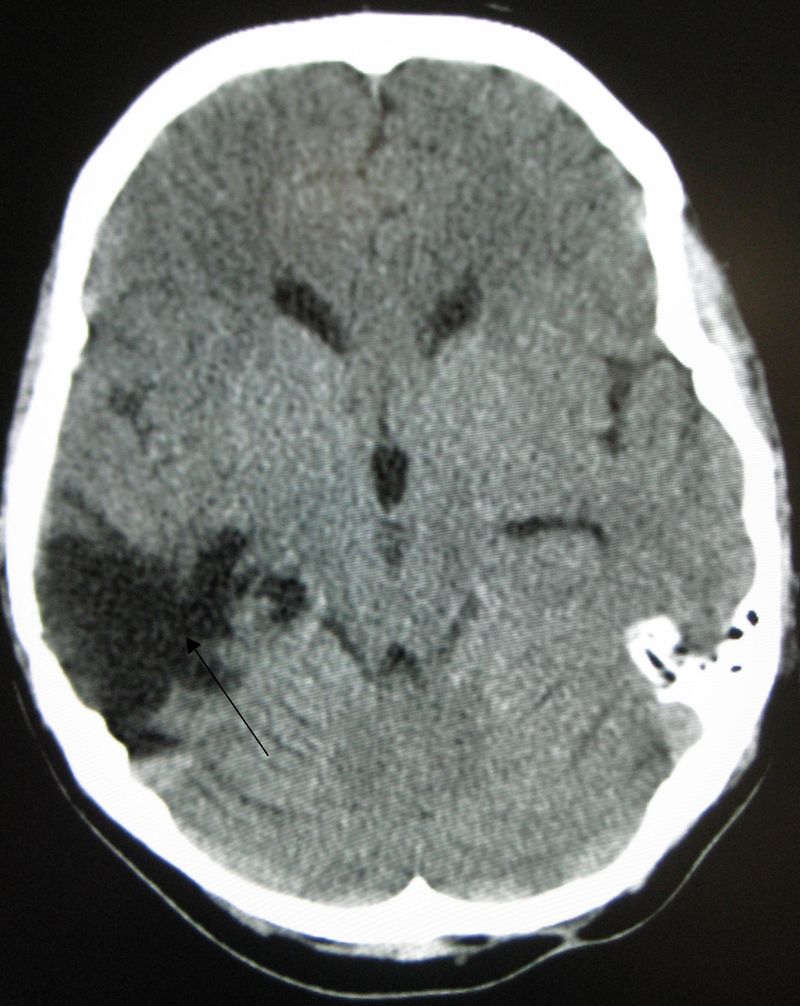
Furthermore, a poorly delineated hemorrhage can be contrasted with a sharply delineated hemorrhage or a well delineated hemorrhage. When a hemorrhage is poorly delineated, its borders are not well defined (as in the image above).
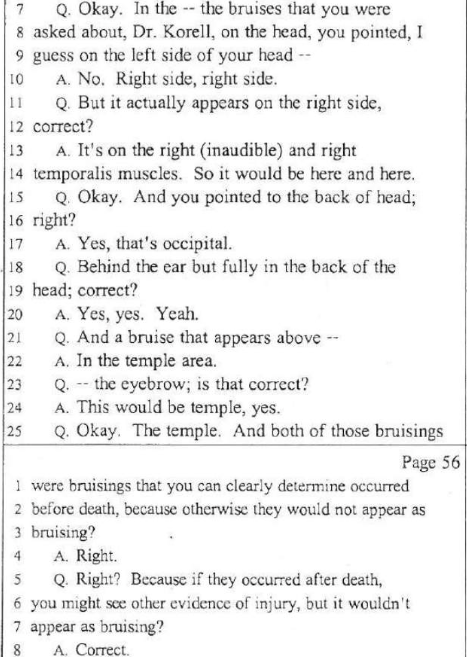
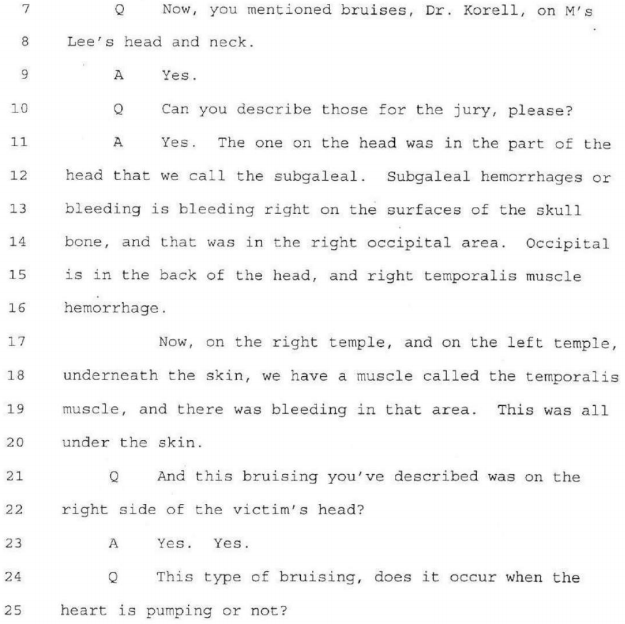
The Hemorrhages Were Antemortem (Before Death)
Finally, we know that the hemorrhages found in Lee’s body were caused while she was still alive. Here are the relevant portions of the testimony of Dr. Margarita Korell, the Assistant Medical Examiner who performed the autopsy on Lee
First Trial:
Second Trial:

Preview
Here is a hyperlink to the interior of a 1998 Nissan Sentra. As you start to think about conclusions 1-5, picture the 5’6″-5’8″ Hae Min Lee in the driver’s seat and the 6’0″ Adnan Syed in the passenger seat. From that visual image, try to picture Syed causing these blunt force injuries and strangling Lee while Lee kicks at him. This is what the experts mentioned in the introduction did.
Conclusions 1-4 are important, but conclusion 5 is obviously the big one. If any readers have any expertise in pathology or a related field and would like to give me additional feedback before my final post, feel free to do so. I would love some additional opinions confirming or contradicting the fifth conclusion.
-CM