
The Autopsy Posts: Vascular Strangulation, Unconsciousness & the Unlikelihood that Hae Min Lee Spoke
Um [Adnan] told me he thought [Hae] was trying to say something while he was strangling her. Um he told me that she kicked like ah knocked off the ah windshield wiper thing in the car and that was it. Jay’s first recorded interview
While we’re at the cliff, we’re standing over looking a whole bunch of stuff at this cliff, you know. [Adnan] starts ah, telling me about how it was when he killed [Hae]. How ah, he said he ah, wrapped his hands around her and her throat and she ah, started kicking him, and he said he looked up to make sure nobody was looking in the car at him. And ah, he said she, he was worried about her scratching him, getting her, his skin underneath her fingernails. And that ah, she was trying to say something. He said that he thinks that she was trying to say that she was sorry, but that’s what she deserved and ah, that she had broken his heart. Jay’s second recorded interview
This is my sixth post about autopsies following my first, second, third, fourth, and fifth post posts. Once again I will be looking at the autopsy report for Hae Min Lee. As I’ve previously noted, “based upon information I have now received from an assistant medical examiner and a pathology resident who has completed extensive rotations in forensics,” the conclusion can be drawn that
2. It is highly unlikely that Lee spoke or even came close to speech if she were being fatally strangled.
So, how can this conclusion be drawn?
If you followed the Eric Garner case, you might have questions about this conclusion.
The Eric Garner case spurred a national debate after there was no indictment.

In that case, Garner died after New York City police officer Daniel Pantaleo “grabbed him by the neck and, with other officers, threw him to the ground and pinned him there.” The cause of Garner’s death was “the compression of [Garner’s] chest and prone positioning during physical restraint by police.” You might recall that there was a big debate about whether Pantaleo had technically used a chokehold on Garner. Moreover, you might recall that there was an even bigger debate about whether a person who can’t breathe can speak given that Garner repeatedly said, “I can’t breathe” while being pinned to the ground. By the end of the debate, most seemed to agree that a person can speak even if he can’t breathe. I won’t go into the full details, but this basic explanation suffices:
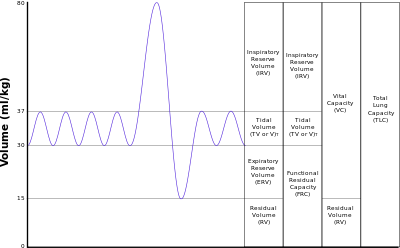
When you take a normal breath you breathe in and out you are breathing about 500ml of air. After breathing out, you are left with ~2400ml of air inside your lungs, this is the Functional Reserve Capacity. If you try to force out as much air as possible, you can still force out ~1200ml more air. This is the Expiratory Reserve Volume. This is air you are able to speak with even if you cannot take a normal breath. Important Note: Notice that the Expiratory Reserve Volume is more than twice the size of a normal breath. That is a lot of air you are able to force out, and a lot of speaking you can do even if you can’t breathe.
So, why am I saying that it was unlikely that Lee was unable to speak or come close to speech while being fatally strangled? The simple answer is that Garner’s case wasn’t your typical strangulation case. According to the Affidavit of James Claude Upshaw Downs, M.D., in Rodriguez v. Maryland, 2008 WL 8083398 (D.Md. 2008),
As is well known, asphyxiation by strangulation is almost always a vascular phenomenon with negligible direct involvement of the airway. The presence of the prominent mucosal and conjunctival hemorrhages is indicative of vascular compression with arterial flow (blood in) relatively preserved compared to venous return (blood out) resulting in ruptures of the small intervening vessels (capillaries) which manifests as such petechial hemorrhages. (emphases added),
How do we know that Lee’s asphyxiation by strangulation was a vascular phenomenon? There are a few reasons, including the fact that Lee had a “[p]etechial hemorrhage of the lower left palpebral conjunctiva.”
A petechial hemorrhage of the left conjuctiva.

In a prior post, I went into detail on petechial hemorrhaging, noting that it is the result of “sustained pressure causing blood vessels in the face and eyes to burst” and is present in approximately 70-91% of strangulation victims.
At this point, you might be wondering how I can conclude that Lee likely didn’t speak or even come close to speech if her strangulation was a vascular phenomenon. After all, Eric Garner did have an airway obstruction and was still able to say, “I can’t breathe” for a minute or so while pinned to the ground. Paradoxically, however, that’s the point. From the testimony of Dr. Daniel Spitz in People v. Grant, 2007 WL 5099802 (Mich.Cir.Ct. 2007):
Q. Now how long does it take for unconsciousness to occur?
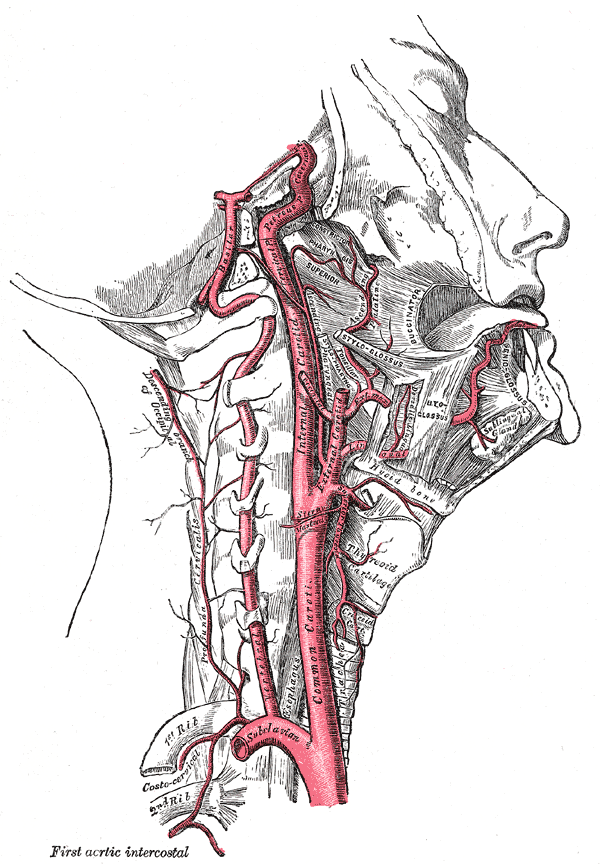
A. Well, unconsciousness is a little variable depending on whether the primary component is a vascular compromise because of occlusion of the carotid arteries which run up the right and left sides of the neck or whether it’s strictly related to an airway compromise because of a compressive force to the upper airway. If it’s purely a vascular strangulation or a vascular component unconsciousness can result in as short as ten to fifteen seconds. If it’s purely a airway compromise, unconsciousness may take a minute to a minute and a half. Many times in strangulation, because of the nature of the interaction, violent interaction between two people, it’s often a combination of both mechanisms. Regardless of how long it takes for unconsciousness, death ensues over a many minute period with the average being about four minutes.
Q. Whether it be by vascular or by restricting the airway, once someone is unconsciousness and being strangled you would not expect any movement from that person, is that correct?
A. No, once unconsciousness occurs then that person would not be engaging in purposeful activity or being engaged in that altercation. (emphasis added).
In other words, because Garner had purely an airway compromise, he was still able speak using the air remaining in his lungs until he lost consciousness a minute or so later. Conversely, Lee was likely only conscious for a mere 10-15 seconds or so before being rendered unconscious. In addition to the above testimony, we can also look at:
1. Deposition Testimony of Melody Arangelovich, M.D., in Beemsterboer v. Joseph J. Duffy, Co., 2009 WL 6841619 (Ill.Cir.Ct. 2009):
In strangulation cases I can tell you if somebody holds the neck for about 10 or 15 seconds, you lose consciousness, and if they continue over 45 seconds, you’re probably never going to recover….
2. Testimony of Noel Palma, M.D., from State v. Berube, 2006 WL 6435568 (Fla.Cir.Ct. 2006):
Now, normally or, in general, when somebody is strangled for about ten, fifteen seconds, you will lose consciousness, and, basically, you may live.
3. Affidavit of Kirk V. Dahl, M.D., in Breslin v. Wisconsin Health Care Liability Insurance, 2014 WL 2435982 (W.D.Wis. 2014):
If there is an interruption of adequate perfusion of the brain tissue by blood, such as one might experience with strangulation, a very rapid loss of consciousness occurs, generally within a few seconds.
That said, there’s no reason to go beyond Adnan’s own trial to find this conclusion. Here’s the testimony of Dr. Margarita Korell, the Assistant Medical Examiner who performed Lee’s autopsy, from the first trial:
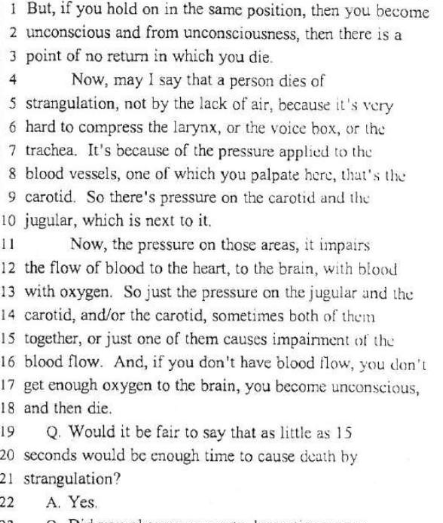
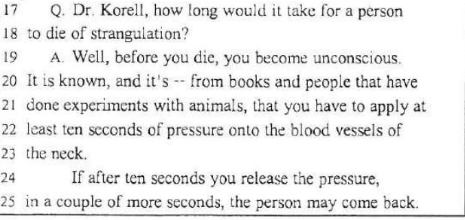
Dr. Korell’s testimony also explains the cause of unconsciousness/death in cases of vascular strangulation: pressure to the jugular veins and/or the carotid arteries prevents blood flow to the brain.
Compression of the carotid arteries is a leading cause of strangulation deaths.
So, where does that leave us? As I noted in my prior post, the blunt force injuries to Lee’s head reflect blows that likely rendered her unconscious or at least stunned. These blows likely occurred just before Lee was strangled or while she was being strangled. Obviously, if these blows rendered Lee unconscious, she couldn’t say or even try to say anything. If Lee were merely stunned from the blows, she probably had at most 10-15 seconds in which she could say or try to say something while in a stunned state and being strangled with enough force to cause petechial hemorrhaging. If you believe that Lee’s blunt force injuries were caused while she was being strangled, her head was likely being banged against some object/surface during those 10-15 seconds.
Jay’s statements from the introduction to this post reflect the Hollywood version of strangulation: a victim who has spurned her ex-boyfriend fighting against being strangled for quite some time before finally resigning and trying to offer up an “I’m sorry.” The reality is that a vascular strangulation usually knocks the victim out in 15 seconds or less, and those precious seconds are usually filled with a violent struggle, rather than anything resembling the victim speaking. The way it was told to me, in the seconds before unconsciousness, the victim’s only goal is to try to prevent her strangulation, which can result in injuries to the assailant but which also often results in the victim scratching or injuring her own throat, chin, or lower face. From the affidavit of Terri L. Haddix, M.D., in United States v. $1,026,781.61 in Funds From Florida Capital, 2012 WL 5363148 (C.D.Cal. 2012):
[I]njuries of the chin or lower face are common in manual strangulation as the victim attempts to protect his/her neck from the hands of the assailant by flexing his/her chin forward.
The lack of such scratches/injuries to Lee’s throat, chin, or lower face suggests that Lee was already unconscious or stunned when her strangulation started or soon thereafter.
It’s not the lack of air in Lee’s lungs that leads me to conclude that Lee was unable to speak during her vascular strangulation; it’s the lack of time.
[Update: Jay gave very similar testimony at trial, with some added embellishments. Here’s the relevant portion of Jay’s testimony from the second trial (2/4/00, page 142):
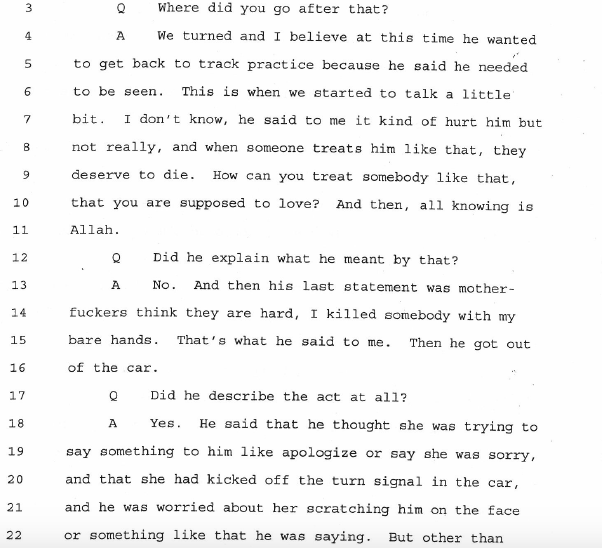
-CM