
Episode Four of “The Case Against Adnan Syed”: Lividity Redux
Tonight’s fourth (and final) episode of HBO’s “The Case Against Adnan Syed” touched upon a topic I’ve covered extensively on this blog: livor mortis/lividity:
livor mortis is the process by which a victim’s blood pools into the tissues of the dependent (lowest) portion of the body after death. After 8-12 hours or so, this lividity becomes fixed, meaning that the pattern of pooled blood won’t be changed even if the body is placed in a different position.
So, what did tonight’s episode add to the analysis?
The investigators for the series spoke with Dr. Jan Gorniak, the Chief Medical Examiner of Fulton County and previously the Deputy Chief Medical Examiner in the District of Columbia. Dr. Gorniak focused on the double diamond pressure marks found on Hae’s shoulder area. Susan Simpson has written about these pressure marks on her blog:
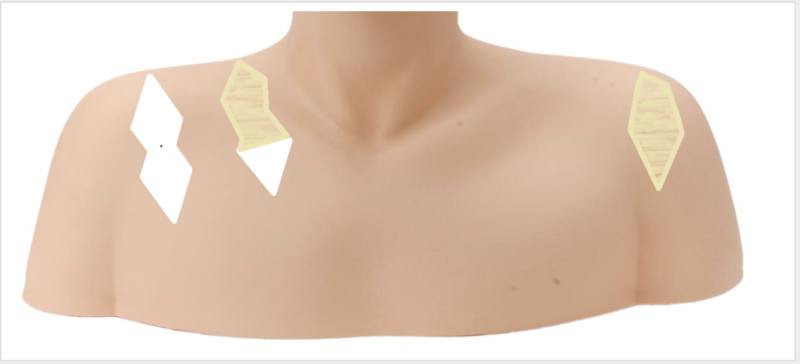
As Susan explains, “[p]ressure causes compression of the blood vessels, which results in blood being unable to settle in those areas, and therefore no discoloration occurs, even in a location that is otherwise the lowest area of the body.” This is reflected in the autopsy report for Hae Min Lee, which states that “[l]ividity was present and fixed on the anterior surface of the body, except in areas exposed to pressure.”
So, as Dr. Gorniak notes in the episode, Hae having fixed anterior (frontal) lividity and these double diamond pressure marks means that Hae had to be face down on top of double diamond objects for 8-12 hours after her death. Therefore, because no such objects were found in Leakin Park by where her body was buried, Hae had to be somewhere else in the 8-12 hours after her death. Given that Hae was likely not killed until 2:30pm (or later), this means that she could not have been buried in Leakin Park until at least 10:30pm:

Dr. Gorniak’s analysis of the lividity supplements the analysis done by Dr. Leigh Hlavaty, who is (1) the Deputy Chief Medical Examiner for the Wayne County Medical Examiner’s Office in Detroit, Michigan; and (2) a Clinical Assistant Professor of Pathology at the University of Michigan.
Like Dr. Gorniak, Dr. Hlavaty reviewed all of the forensic evidence in the case. And, like Dr. Gorniak, Dr. Hlavaty concluded that Hae Min Lee could not have been buried in Leakin Park until at least eight hours after her death:
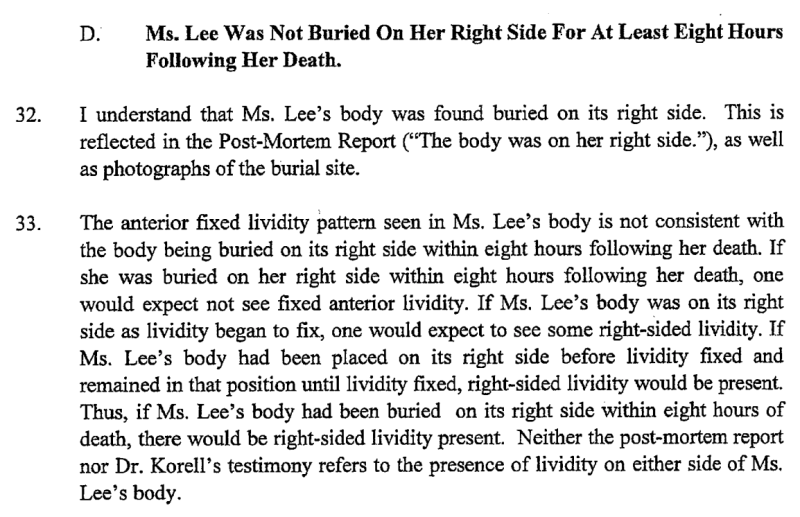
So now we have two reasons why a burial in the 7:00pm hour doesn’t make sense: (1) the right side burial is inconsistent with the anterior/frontal lividity; and (2) there were no objects by Hae’s body that could have caused the double diamond pressure marks.
So, what does it all mean? Like Judge Welch, the Court of Appeals of Maryland has now concluded that the “crux” of the State’s case against Adnan was the intersection between Jay’s testimony about burying Hae in Leakin Park, the Leakin Park pings, and Hae’s body being found in Leakin Park.
But the calls leading to the Leakin Park pings were the 7:09 and 7:16pm calls on Adnan’s call log. And, in his Intercept interview, Jay says that (1) Adnan dropped him off at his house at about 6:00pm; (2) Adnan returned “several hours later, closer to midnight;” (3) they got some gardening tools; (4) they drove over to Leakin Park; and THEN (5) Adnan buried Hae. And NOW, we have two well credentialed and well respected medical examiners concluding that Hae wasn’t buried until 10:30pm at the earliest.
Now, not only does Jay’s story about the burial lack corroboration (due to the AT&T disclaimer
If there’s no way that Hae was buried until 10:30pm, there’s also no way that Jay told Jenn about the burial at 8:00ish. Simply put, this makes it clear that Jenn is lying or mistaken about Jay telling her about the murder/burial on January 13th. Of course, Jenn also says that Jay and she went to Kristi’s place immediately after Jay (said he) wiped down the shovels, with the HBO series also revealing that the trips to Kristi’s place did NOT happen on January 13th. So we now have multiple reasons why Jenn is removed as meaningful corroboration for Jay.
-CM